Home / Short Stories / An Ides of May Beauty

An Ides of May Beauty

Just to make it clearโ€”I was not there when the following events occurred.  The facts are pretty true, at least as far as historical documents suggest.  How it all came together, only the participants know for sure, but this is how it happened–in my mind.

It was mid-May and the narrow, steep route over the mountain pass was moist but clear of snow.  A month before, Harry Burke had fought the drifts at this point.  Two months before that, he had only been able to negotiate his way by following the ruts that oxen, stationed on top of the pass, created by pulling sleds through the snowpack.

It was a bright May day on the road between Shasta City and Yreka.  The trip was advertised to take about 24 hours, with horse changes and rider-rests at several places between the two boomtowns.  The route had been in operation since the late 1850s and now, nearly a decade later, was accepted as the best and safest way to pass through extreme northern California.

Stager or โ€œWhipโ€ Burke had made the trip dozens of times and enjoyed the beauty of the mountains seen in all directions.  Driving the stage, addressing passenger and livestock problems and making repairs took constant attention.  Even so, nature enveloped the travelers and driver.  Deer were abundant and occasional elk or bear were seen.  But, at this time of year, the best was the expanses of wildflowers carpeting each opening and meadow.  

Professor Wood was excited to be in California and wanted to see everything he could.  So, early on during the trip he likely requested to ride up top with the โ€œWhipโ€ to get a better view of the country and to talk with the gentleman in charge.  The curious traveler was Alphonso Wood, who had spent much of his life attending school, teaching and preaching in the East and Midwest.  He had written a book that was a standard botanical text of the times.  For Mr. Wood was not only a theologian and school administrator but also a plant expert.  Now, recently retired, he was fulfilling a life-long dream– to view the plants of the American West.

While the two men sat next to each other, crossing gulches and streams, they must have become interested in each otherโ€™s lives.  Whip Burke had never met a person that had written books or was an expert regarding plants. What was life like as a professor?  Who bought his books?  Why had he come out West?  During their ride along the stage route Alphonso would have asked Harry many questions:  Perhaps about the Whipโ€™s life; how he ended up in northern California; about the earlier route east of Mt. Shasta and the Pitt Indian attacks that halted its use; about Harryโ€™s family, both back East and in California.  The plant-loving tourist would have learned about some of the stage driverโ€™s family setbacksโ€”deaths of parents and guardians back East and a failed marriage.  However, the topic of Burkeโ€™s daughter, Ida May, who stayed with others back in Shasta City while her father was working, must have been an important topic.

Occasionally, when the stage stopped to let the horses blow or to get a drink of water, Professor Wood would have jumped down from the seat that he had claimed for the ride and scanned the nearby plants.  If he had time, he would dig up a plant he was not familiar with and carefully placed it in the book-press he always kept nearby.  Along with the stretched out plant he would add a note describing the location and habitat where the plant was found.  In the dry air at this time of year, the plants quickly desiccated and would be preserved for many years.

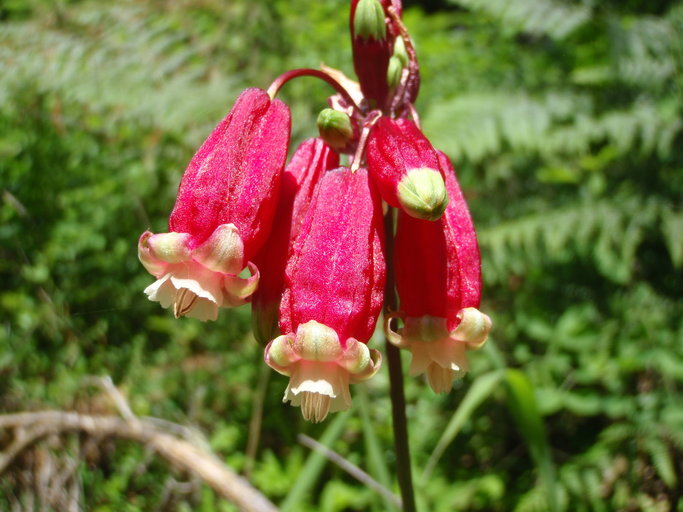
After a stop near the top of the pass, either stager Burke or Wood saw a spectacular flower!  It had a tall straight stem, ending in a cluster of tubular, scarlet flowers.  Each tube had a cream-colored lip.  Stage driver Harry would have looked over the plant held by Wood.  Yes, he would have told Wood he had seen the flower before, not only here but at other scattered slopes back towards Shasta City.  He did not know its name and was not aware of what other people in the area called it.

Heading downhill, on the way toward Scott Valley, Wood and Harry Burke might have continued with their talk.  The phrase โ€œIdes of Mayโ€ came up, as it was, in fact, almost the middle of the month.  Then the men brought the conversation back to Ida May.  Ida Mayโ€”the Ides of May!  

That evening the stage got to Yreka and Wood probably claimed a bed at a Miner Street hotel.  Before sleep he would have opened his plant-press to look at his rapidly enlarging collection and to change drying pads.  While pausing at the divider section containing the scarlet flower collected just hours before he took out his pen and added to the plantโ€™s note card: the driverโ€™s name, some bits about his life and the name of his little daughter that he was so proud of. 

Months later, back at his home in the East, Wood took time to examine all of his plant collections and notes.  He found that a number of plants had not been scientifically described before, including the beautiful scarlet one found on Scott Mountain.  Woodโ€™s botanical procedure was to carefully make measurements of the plant parts and draw several sketches.  According to scientific protocol, he had the right and privilege to give it a scientific name– which he did.  

Through the years botanical experts have changed their opinions of how the species that Wood found near Scott Mountain is related to other plants, but it has retained the species name of โ€œida-maiaโ€.   Some people call it California fire-cracker flower but I prefer to call it Ida May Brodiaea.  

Life continued, not only for Mr. Wood back East, but for Mr. Burke.  He retired from stage driving and took other jobs, perhaps so that he could be closer to his daughter.  Ida May Burke passed away just a short time later, as a young girl, and was buried in Shasta City.  Years later father Frank Burke also died and was placed next to her.  

Perhaps now, when we are fortunate enough to see this flower in our high country, we might think of all three of the characters and the stage ride between Shasta City and Yreka.

Thanks to Pastor Bob for discussions about the history behind this story.


Leave a Reply

Your email address will not be published. Required fields are marked *