
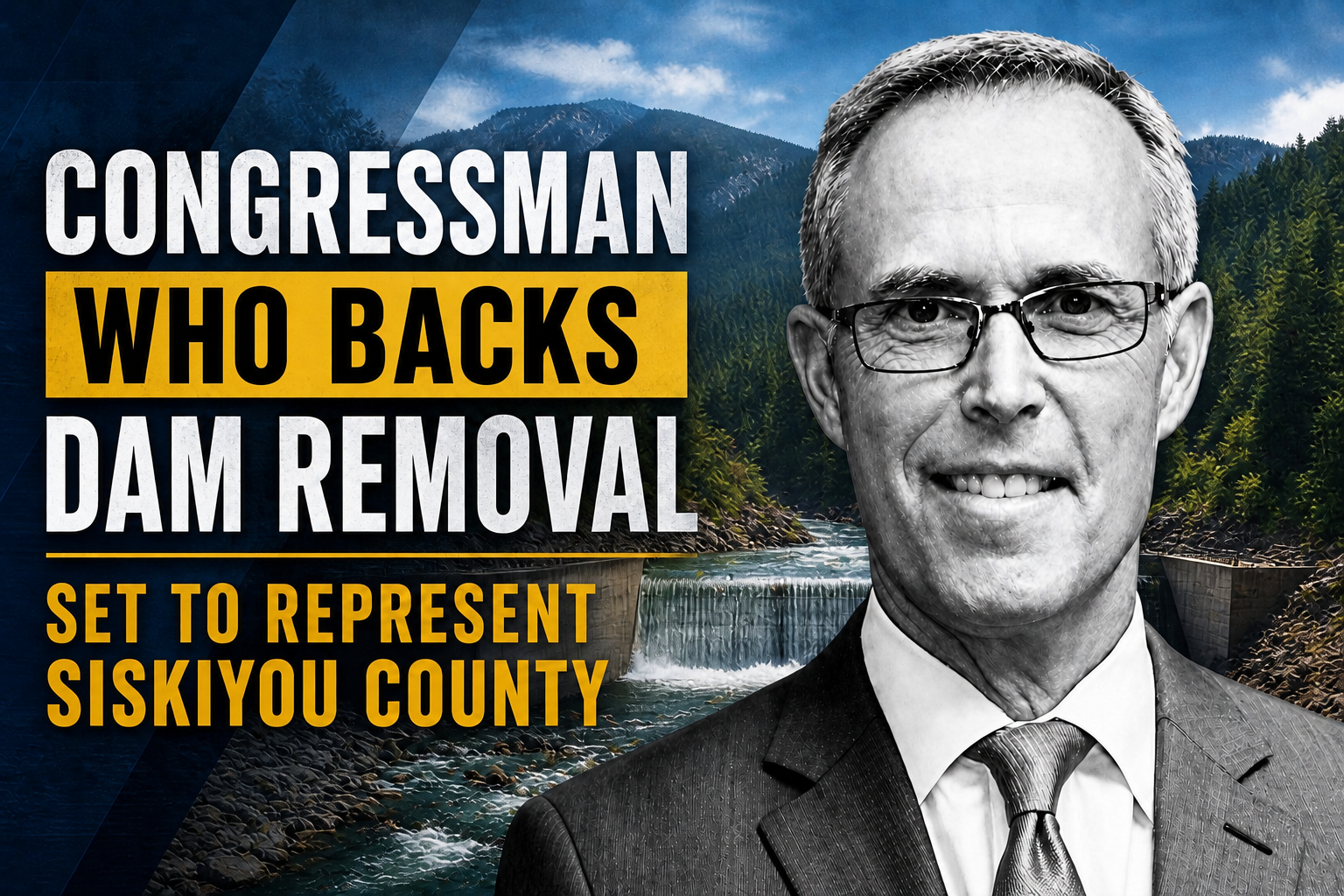
Home / Siskiyou News / Congressman Who Backed Dam Removal Set to Represent Siskiyou County

Congressman Who Backed Dam Removal Set to Represent Siskiyou County

Huffman’s environmental record, coastal donor base raise questions as Prop 50 redraw places rural North State under Marin Democrat’s authority

A congressman whose career was built opposing rural water infrastructure and who is currently using his committee authority to block federal efforts to save a century-old dam system serving 750,000 people will soon represent Siskiyou County in the U.S. House of Representatives โ€” whether the county likes it or not.

Rep. Jared Huffman (D-San Rafael) has represented California’s 2nd Congressional District since 2013, operating out of Marin County, one of the wealthiest and most politically progressive counties in the state. Under the Prop 50 redistricting maps passed by California voters in November 2025 โ€” opposed by 62.5% of Siskiyou County voters โ€” Siskiyou, Modoc, and Shasta counties will shift into Huffman’s district beginning with the 2026 election.

The timing could hardly be worse for rural North State communities already fighting to preserve their water.

A Career Built Against Rural Water Infrastructure

Before entering politics, Huffman worked as a senior attorney for the Natural Resources Defense Council, a national environmental litigation organization whose stated mission includes opposing what it calls the “overdevelopment” of water resources in the American West. He later served 12 years on the Marin Municipal Water District board. In the California Assembly, he chaired the Water, Parks and Wildlife Committee. In Congress, he has served on the House Natural Resources Committee for more than a decade and was named its Ranking Democrat โ€” the top minority position on one of the most consequential committees for Western land and water policy โ€” in late 2024.

Upon receiving that appointment, Huffman said: “My entire career has been centered around natural resources โ€” from my time as an attorney at the Natural Resources Defense Council to the past twelve years serving on this committee.”

That career has earned him a 100% score on the League of Conservation Voters’ 2025 National Environmental Scorecard and a 98% lifetime rating โ€” placing him among the most reliably anti-development votes in Congress on natural resource issues. His campaign donor base reflects those loyalties: public sector unions, tribal gaming interests, and conservation-aligned PACs dominate his fundraising profile. Big agriculture and the hydropower industry are conspicuously absent.

The groups that have formally supported his legislative work read like a directory of national environmental advocacy: the Sierra Club, the Natural Resources Defense Council, Defenders of Wildlife, the League of Conservation Voters, the Alaska Wilderness League, and the Wilderness Society.

None of those organizations have a significant constituency in Siskiyou County. Many of them have actively litigated against the kind of land and water use that sustains ranching, logging, and agricultural communities across the rural North State.

The Potter Valley Project: A Case Study in Conflicting Priorities

The clearest window into what Huffman’s representation will mean for rural Northern California is playing out right now on the Eel River, roughly 150 miles south of Yreka โ€” and it isn’t encouraging.

The Potter Valley Project, a century-old dam system on the Eel River in Mendocino County, supplies water to approximately 750,000 farmers, ranchers, and rural residents across the North Coast. PG&E, which owns the project, has been moving toward demolishing its two dams โ€” Scott Dam and Cape Horn Dam โ€” after the project became economically unviable as a hydropower generator.

Huffman has advocated for removing those dams since at least 2020, when he publicly stated that demolition was “the only way to achieve the fish goal” โ€” meaning salmon restoration on the Eel River. In a 2022 letter to federal regulators, he called the project “outlived its usefulness” and pushed for the removal process to move “expeditiously.”

Then the community pushed back.

Following a September 2025 letter signed by over 900 farmers, ranchers, tribal leaders, and residents asking the federal government for help, Agriculture Secretary Brooke Rollins intervened. Her office responded in December, held a community roundtable in January, and committed to working across federal agencies to protect the valley’s water supply. The Elsinore Valley Municipal Water District, a Southern California public water agency, subsequently announced interest in purchasing the dams, resuming hydropower production, and continuing water deliveries.

EVMWD Vice President Darcy Burke was direct about her district’s intentions. “I have no intention of stealing your water,” she said. “No intention of changing how Potter Valley lives. What we want to make sure is that it’s protected โ€” that somebody else can’t come back and want to take down the dams, that whatever water that you need is still affordable.”

Huffman’s response was to launch a congressional investigation.

He sent formal demand letters to Secretary Rollins, Interior Secretary Doug Burgum, and directly to EVMWD, calling for all records related to the potential acquisition. On social media, he framed the federal intervention โ€” which came at the explicit request of the community โ€” as “a massive water grab” and a Trump administration scheme.

Then came the warning. In a Facebook post, Huffman addressed the Trump administration and “anyone else involved”: “You need to come clean. And if that’s a problem, it’s going to be a bigger problem at this time next year.”

That “next year” is not an empty phrase. As Ranking Member of the House Natural Resources Committee, a Democratic House majority in 2027 would hand Huffman the gavel โ€” and with it, full subpoena power over every agency and entity involved in trying to save the Potter Valley Project.

A sitting congressman, wielding the authority of a senior committee position, is threatening the officials who responded to a community’s cry for help. He calls it oversight. The 900-plus signers of that September letter might call it something else.

Prop 50: Representation Imposed, Not Chosen

The redistricting that will deliver Siskiyou County into Huffman’s district was not a neutral exercise. Proposition 50 โ€” formally titled the “Election Rigging Response Act” by Gov. Gavin Newsom โ€” was a Democratic legislative response to Republican redistricting in Texas, passed through a special election in November 2025 and designed explicitly to flip Republican-held congressional seats in California.

The Siskiyou County Board of Supervisors unanimously opposed it. So did most of the rural North State electorate that will now live under its maps. Shasta County voted 70% no. Lassen County voted 80% no.

The maps pair Siskiyou, Modoc, and Shasta counties โ€” rural, agricultural, resource-dependent, and heavily Republican-leaning โ€” with the far more populous coastal communities of Marin, Sonoma, Mendocino, Humboldt, Trinity, and Del Norte. In any election, the coastal population centers will dominate. Rural voices will be numerically swamped.

That structural reality means that even if Huffman makes a show of listening to North State concerns โ€” and to his credit, he has held some meetings with rural constituents in the past โ€” the political incentives will always point toward his existing base. Marin County donors, LCV endorsements, and Sierra Club support built his career. Siskiyou County ranchers did not.

What It Means for the North State

For Siskiyou County, the practical consequences of this representation shift deserve straight talk.

The issues that most directly affect this community โ€” water rights, grazing allotments on federal land, timber harvest on national forests, wildfire management policy, rural road access, and agricultural water security โ€” are precisely the issues where Huffman’s record and his institutional backers point in the opposite direction from rural North State interests.

His allies at the NRDC and Sierra Club have litigated against timber harvests in Northern California national forests. The LCV, which funds his campaigns and bundled donations for him, consistently rates members based on votes that restrict rather than enable rural land use. His position on dam removal โ€” driven by salmon restoration goals his environmental donors have championed for decades โ€” treats the water security of farming communities as an acceptable cost of ecological progress.

None of that makes Huffman a villain. It makes him a congressman whose career was built serving a different constituency, now being assigned a new one he didn’t ask for and likely doesn’t fully understand.

But Siskiyou County has a right to understand who is coming. And right now, the clearest signal of what that representation will look like is a sitting congressman using committee authority to investigate and pressure the agencies trying to protect rural water โ€” while warning that worse is coming if his party wins back the House.

That’s the congressman Siskiyou County will send to Washington in 2026.


Editorโ€™s Note

This reporting is based on Rep. Jared Huffmanโ€™s own public statements and congressional recordsโ€”including his 2020 and 2022 comments on dam removal, his April 2025 Ukiah town hall remarks, his April 2026 demand letters to federal secretaries and the Elsinore Valley Municipal Water District, and his public Facebook and Instagram postsโ€”as well as the September 2025 community petition signed by more than 900 residents, official responses from the U.S. Department of Agriculture, statements by EVMWD Vice President Darcy Burke, Proposition 50 election results certified by California counties, League of Conservation Voters scorecards, and independent coverage by UNWON.

Siskiyou News is the adjudicated newspaper of record for Siskiyou County. News tips and public records inquiries can be directed to [email protected].


Leave a Reply

Your email address will not be published. Required fields are marked *