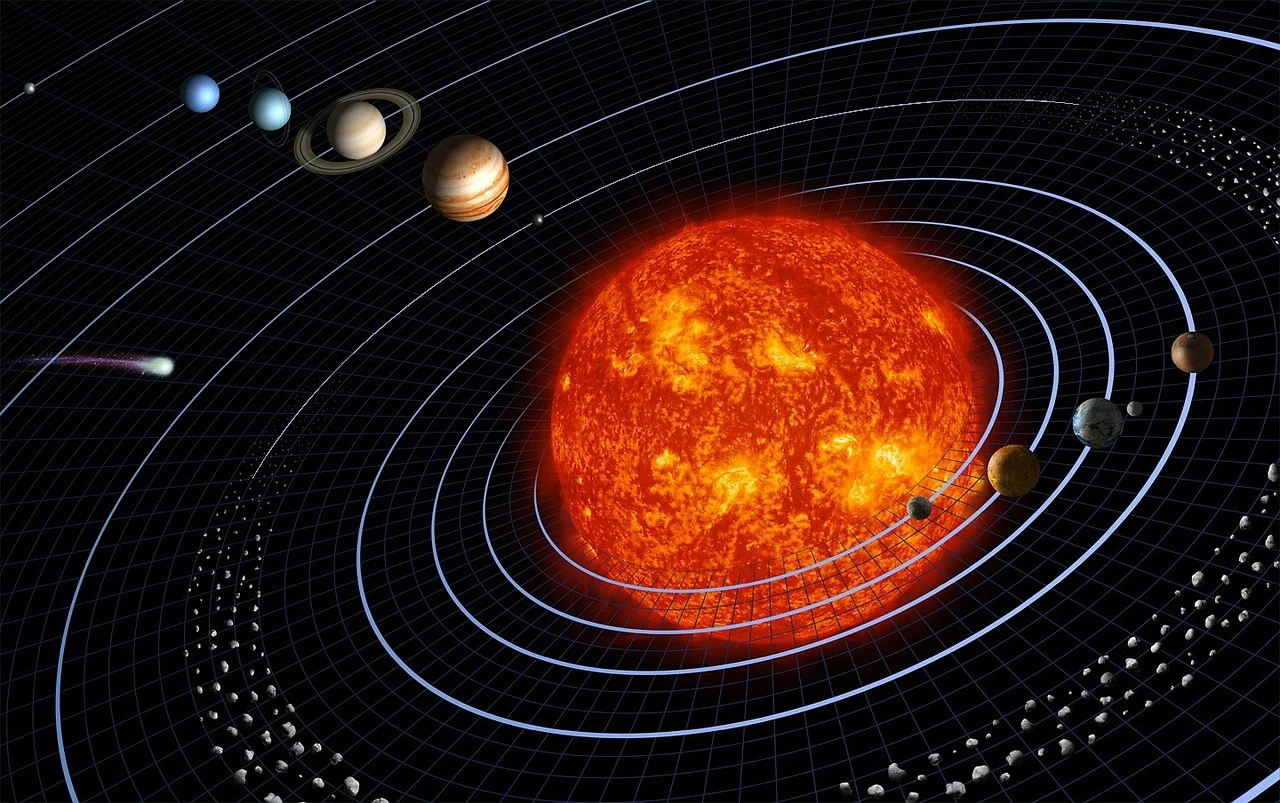
The Moon will be new on the 21st this month. There’s a lot going on skyward – comets, Solar flares, Solar storms and CME’s (coronal mass ejections). This has truly been a spectacular Solar Maximum, which began to rear its head in October, last year.
Compared to 2022, the Sun is extremely active. You can find images on YouTube of the Sun from 2022, to compare with how our star looks today. This is ramping up to be the most active Solar Maximum in 100 years or more.
Have you noticed that many tumultuous phenomena have ramped up over the last months – earthquakes, volcanic activity, political chaos, social unrest? This is a time of dramatic change. Many learned voices are saying this is a time of huge transition, within the 26,000 year precessional cycle, the time it takes the Earth to make one complete rotation of the slow wobble of its axis. This wobble is what gives us the four seasons.
According to the Hindu Yuga Cycle, we are leaving the Kali Yuga; the darkest of ages within the cycle, also known as the Iron Age; and are entering the Bronze Age or Dwapara Yuga.
This coincides with the Astrological Cycle we are in; we are leaving the age of Pisces and entering the age of Aquarius, with each cycle lasting approximately 2,200 years.
Both systems, the Yuga and the Astrological cycles are saying we’re moving out of the age of power-over, top-down, competitive acquisition of things and power, and the resulting conflicts, into an era of more decentralized, bottom-up, inside-out and community-based societies. Say Hallelujah!
From another perspective, Chaos Theory ascribes that the process of change requires a period of chaos before an evolutionary shift occurs. It’s a bit like cell mitosis. At the beginning stages of cell division, an area of what appears to be chaotic processes begins to form in the midsection of the mother cell before two “daughter” cells are formed. Folks, in my opinion, we are in the soup of transformation.
Seen from yet another vantage point, change usually doesn’t truly begin until things get existentially challenging. When you can’t afford groceries, your monthly car payment, your mortgage or when you’ve lost your job or healthcare, you might begin to look at what changes will be required. This is a time for awareness and flexibility.
As an illustration of existential transits of former ages, heres an interesting astrological observance – the Age of Taurus, 6,600-4,400 years ago (4,400-2,200 BCE) was a time of Matriarchal societies. As in American indigenous societies, the grandmothers oversaw the health and balance of the tribe. Men played major roles, but adhered to the wise council of the elder women. There were no wars recorded until 2,700 BCE, towards the end of the age of Taurus and approaching the age of Aries, (ruled by the planet Mars, the God of war).
Populations thrived during the Taurean era, living within decentralized societies where, as in the Natural world, collaboration, cooperation and mutual benefit ruled the day.
The age of Aquarius, which we are transitioning into, is characterized as an age of decentralized, community-based, inside-out and bottom-up social structure. No kings! No oligarchs! No more greedy politicians!
But I’ve digressed from the topic of this column long enough. Back to the garden.
Briefly, let’s talk about garden duties for this time of year. The most important focus in my garden, at this time, is putting all that organic material from garden cleanup into composting.
Years of trial and error have taught me a few things. Being fairly lazy, especially this time of year, I build my compost piles loosely. I find that a bin at least four feet in diameter offers enough area to get the thermophilic bacteria cooking. I use old stock panels or large pallets to contain my compost. My recipe is to throw some “green”waste in and then some “brown” waste.
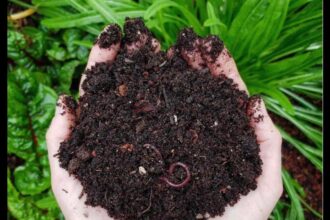
“Green” waste is your garden debris. It’s fresh, green and full of nitrogen. The “brown” waste is dead and dried up material, leaves, straw, etc, and is full of carbon. When nitrogen and carbon get together, they feed the bacteria, which heat up the pile and break down green and brown into hummus – black gold – the richest fertilizer for the spring garden.
From my experience, it doesn’t take much green to kickstart the break down process. I’ve read that a ratio of 25 parts brown to 5 parts green will get the process going.
As an illustration of how little green nitrogenous material is required, I ran a community composting project in Dunsmuir a couple decades ago. My inspiration was to decrease leaf burning in town. With the City Council’s blessing, a location and free water, neighbors began bringing their leaves to our site. Within 6 weeks of accumulation and watering, we had a long mound of leaves 35 feet long, eight feet wide and tall. Using only leaves, we were surprised to find a steaming center the first time we turned the pile with our kubota. By spring I was able to share the finished product with many neighbors in town, about eight yards of black gold.
So, recycle your garden waste into rich fertilizer. I find it’s best to locate your pile where it gets filtered Sun. As with all living things, your compost pile will require regular water.
Compost happens! In the meantime remember time spent near a creek or in a forest helps you feel lighter and per and makes the world look brighter.
Siskiyou News welcomes open letters from readers on issues affecting our county.
- CALFIRE SISKIYOU UNIT HAND CREW SELECTED FOR BLUE RIBBON AWARD
- 10th DAA selects Kenny Elwood for 2026 Golden Pass
- FICTITIOUS BUSINESS NAME STATEMENT: Carson’s Window Coverings & More
- Traffic Stop in Siskiyou County Leads to $1.9 Million Cocaine Seizure, Driver Arrested
- F-35A Lightning II Jets from Luke AFB Arrive for Two-Week Training at Kingsley Field