State Implements Temporary Shasta River Flow Adjustments for CDFW-Led Salmon Study
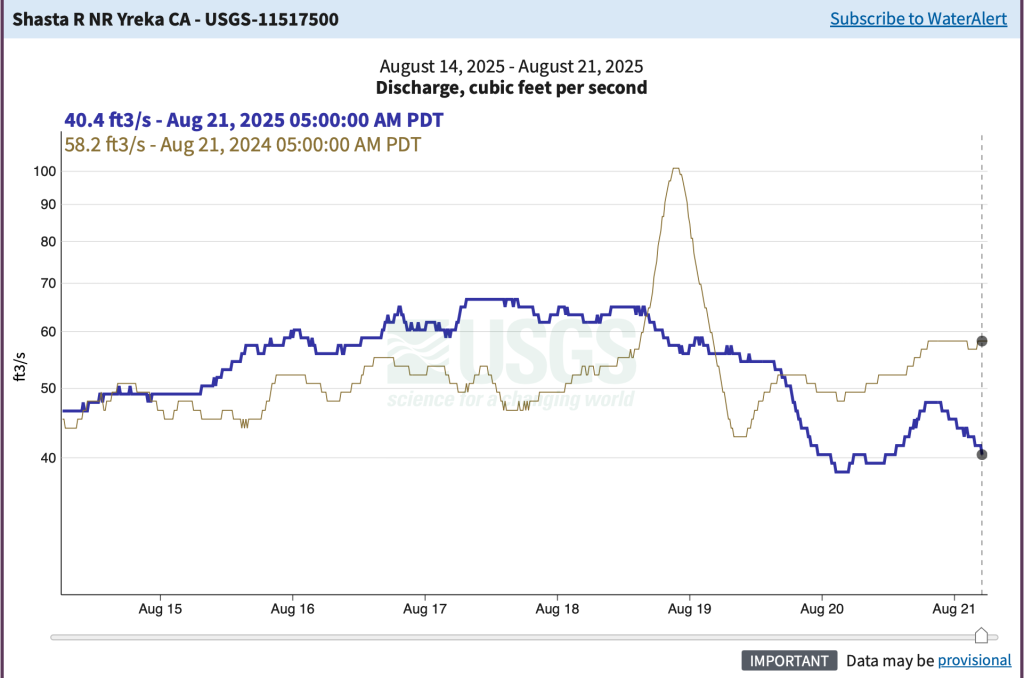
Yreka, California โ August 21, 2025 โ The California State Water Resources Control Board (SWRCB) is enforcing a 15-day alternative flow schedule in the Shasta River from August 20 to September 2, in direct response to an August 4 request from the California Department of Fish and Wildlife (CDFW). This temporary regime overrides the standard 50 cubic feet per second (cfs) drought emergency minimum to facilitate a pilot study on variable flows’ impacts on threatened salmonids.
The schedule specifies:
- Days 1-7: Flows commence at 45 cfs, reduce to 40 cfs (including a brief 0 cfs ramp on Day 2), and rise to 50 cfs.
- Days 8-15: Flows increase to 60 cfs for the majority, then taper to 50 cfs.
SWRCB’s authorization, under Emergency Regulation Section (c)(2)(D), enables data collection on river temperatures, water quality, habitat utilization, and fish health for species such as coho and Chinook salmon. The study tests whether variable flows offer comparable or enhanced protection versus fixed minimums. The Shasta Scott Watermaster District oversees daily operations, while CDFW conducts on-site monitoring, including salmonid surveys and water assessments in key areas like Shasta Canyon pools. CDFW retains authority to revert to 50 cfs immediately upon detecting fish mortality or distress.
This action aligns with broader drought regulations readopted in January 2025, amid the ongoing Klamath River dam removals, which aim to restore upstream salmon migration routes.
Farm Bureau Capitalizes on Pilot for Independent Data Collection
The Siskiyou County Farm Bureau is actively cooperating with CDFW and the Watermaster District to moderate water deliveries, ensuring stable conditions at targeted flows like 40 cfs and 60 cfs. Leveraging this period, the Farm Bureau is supporting an independent study by Applied River Sciences to measure river temperatures and related parameters at these levels. The goal is to produce localized, evidence-based insights on flow impacts, which could refine future state regulations and counterbalance top-down mandates with community-driven data.
Substantial Funding Fuels Shasta River Science and Conservation
Science and habitat restoration on the Shasta River represent significant investment, with millions in state grants awarded in 2023 under CDFW’s Drought Emergency Salmon Protection program underscoring the “big business” of salmon recovery. These projects, many ongoing, complement the current flow pilot by addressing coho supplementation, habitat enhancements, and drought resilience studies. Key awards include:
- Karuk Tribe ($1,275,000): Collaboration with CDFW to test coho salmon supplementation using Remote Site Incubators (RSI) at Big Springs Ranch Wildlife Area. Eyed eggs from Fall Creek Hatchery are placed in RSIs fed by Big Springs water, allowing natural hatching and rearing in the Shasta River.
- Karuk Tribe ($1,500,000): Joint effort with Yurok Tribe for fish passage improvements in Little Springs Creek at Big Springs Ranch, including barrier removal for access to Little Springs Lake, habitat evaluations, restoration plans, and instream enhancements for salmonids.
- Siskiyou County Farm Bureau ($3,212,500): Partnership with CDFW to engage landowners in water conservation via field fallowing and upgraded stock water systems, reducing diversions in critical areas of the Scott and Shasta Rivers. Includes monitoring to inform future strategies.
- California Trout, Inc. ($2,812,500): Restoration of aquatic habitat along Shasta River reaches on seven ranches under the Shasta Safe Harbor Agreement (SHA), targeting recovery of threatened coho salmon amid historical land-use declines.
- California Trout ($1,727,029): Scientific study on drought resilience in the Upper Sacramento Basin, including Shasta springs. Focuses on recharge areas, subsurface residence times, drought-induced changes, and benefits to native fishes, interpreted for Shasta Reservoir management and listed species.
- Montague Water Conservation District ($1,500,000): Evaluation and implementation of conservation at Hole in the Ground Ranch under the SHA, including stream crossing improvements, riparian fencing enhancements, and off-channel stock water systems.
- California Trout, Inc. ($500,850): Investigation of Evans Spring reconnection to Little Shasta River, quantifying habitat benefits from added instream flows during extreme drought to guide designs and protections.
These initiatives, totaling over $12 million for Shasta-related efforts, highlight collaborative science between tribes, nonprofits, farmers, and agencies, amid local concerns over regulatory overreach and water rights.
Sources:
https://www.waterboards.ca.gov/drought/scott_shasta_rivers/docs/2025/CDFW-recommendation-shasta-temp-flows-study-2025.pdf
https://content.govdelivery.com/accounts/CAWRCB/bulletins/3eecacc
https://wildlife.ca.gov/Conservation/Watersheds/Restoration-Grants/Awards
https://caltrout.org/news/caltrout-awarded-cdfw-funds-for-shasta-region-salmon-habitat-restoration-and-drought-resiliency-projects
- FICTITIOUS BUSINESS NAME STATEMENT: Carson’s Window Coverings & More
- Traffic Stop in Siskiyou County Leads to $1.9 Million Cocaine Seizure, Driver Arrested
- F-35A Lightning II Jets from Luke AFB Arrive for Two-Week Training at Kingsley Field
- Mountain Lion F29 to Be Relocated Again โ Residents Question Whether It Will Stick
- Fake Virus Alerts, Phishing, and Online Scams: How to Protect Yourself From Today’s Most Common Digital Threats