
Home / Latest News / Urgent Action Needed to Save Endangered Fish in Upper Klamath Lake

Urgent Action Needed to Save Endangered Fish in Upper Klamath Lake

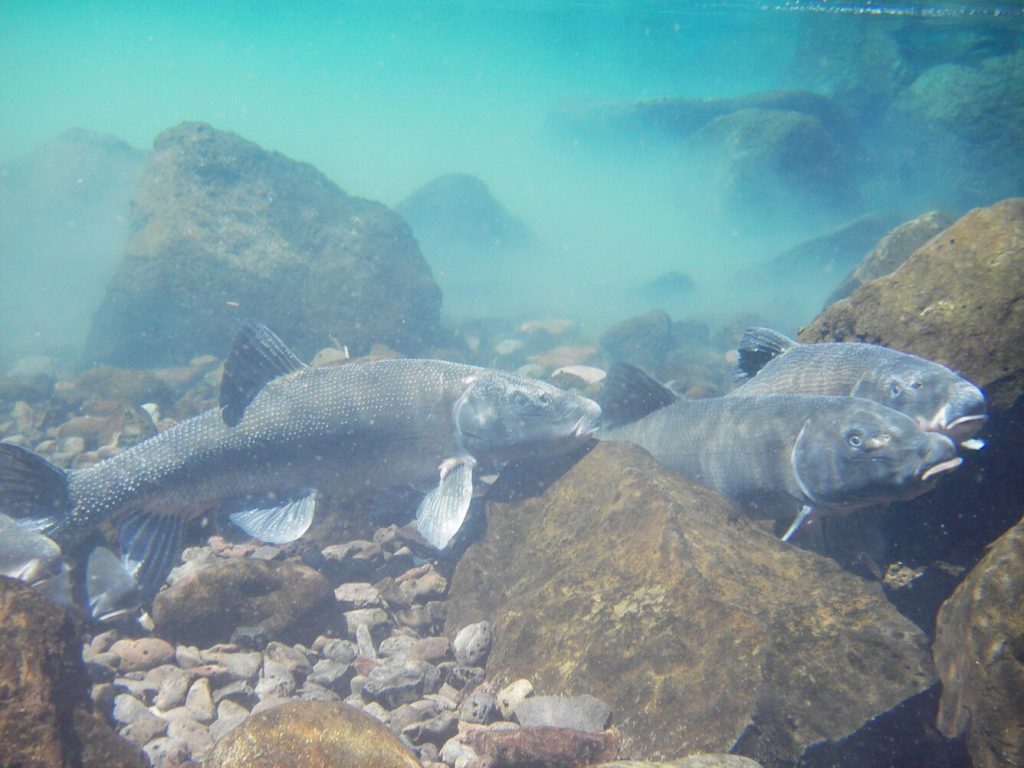
Lost River suckers congregating to spawn on Sucker Springs in Upper Klamath Lake, Oregon.
Sources/Usage Public Domain

The number of adult endangered Lost River and shortnose suckers in Upper Klamath Lake, the primary remaining habitat for these species, declined by 65 to 85 percent between 2001 and 2020. Extinction is increasingly likely for these species unless their population trajectories can be changed. The Klamath Tribes, the U.S. government, the State of Oregon, and several nonprofits are working together to prevent sucker extinction in the Klamath Basin

Recent monitoring data has revealed a critical situation for two endangered fish species in Upper Klamath Lake, Oregon. The Klamath Water Users Association (KWUA) is calling for immediate action to prevent the potential extinction of C’waam and Koptu, also known as shortnose and Lost River suckers.

Federal and tribal biologists have observed a significant decrease in adult fish detected at various spawning locations. Tracey Liskey, KWUA President, stated, “Regulating water levels and fighting about water levels are distractions that have not helped these fish.”

Key findings include:

  • Fewer than 1,000 adult Lost River suckers were detected at shoreline spawning sites in Upper Klamath Lake this year, down from thousands in previous years.
  • The number of both species spawning in the Williamson River has dropped to less than a quarter of the figures seen in 2016 and earlier.

Historical Context and Decline

The plight of these species is rooted in a long history of human impact on their habitat:

  • 1820s: Removal of beavers began the decline of wetlands in the Klamath Basin.
  • 1906: The federal Klamath Project initiated, leading to drainage of most sucker habitat in Tule Lake and Lower Klamath Lake.
  • 1950s: Harmful cyanobacteria replaced diverse algae in Upper Klamath Lake.
  • 1960s: Massive die-offs occurred, and by this time, about two-thirds of upper Klamath Basin wetlands had been drained.
  • 1986: Sucker fishery closed; Klamath Tribes voluntarily stopped harvesting.
  • 1988: Lost River and shortnose suckers listed as endangered.
  • 2001-2020: Adult sucker population in Upper Klamath Lake declined by 65 to 85 percent.

Since 1991, the U.S. Fish and Wildlife Service has primarily focused on managing water levels in Upper Klamath Lake to protect these species and improve water quality. However, KWUA’s Director of Water Policy, Moss Driscoll, points out that this strategy has proven ineffective:

“All data overwhelmingly point to the conclusion that only two age-classes of fish, one from the early 1990s and the other from the late 1960s, have led to significant recruitment of fish into the adult population,” Driscoll explained. “Whether we see high lake levels or low lake levels, poor water quality or good water quality, the hundreds of millions of larvae hatched each year just don’t survive to adulthood.”

Recent efforts to stabilize the population through captive rearing programs have shown limited success. Driscoll suggests that the strategy needs to evolve, possibly by “growing the fish larger, or releasing them in other locations, or both.”

Interestingly, both species are thriving in other water bodies, including those served by Klamath Project infrastructure and even in canals and drains within the Klamath Project. Clear Lake Reservoir, which has different ecological conditions than Upper Klamath Lake, also hosts healthy populations of both species.

The KWUA emphasizes the need for urgent, effective measures to address this crisis. “Farmers believe in solving problems,” said Liskey, highlighting the agricultural community’s willingness to participate in conservation efforts.

As federal agencies prepare to release final figures later this year, the KWUA stresses that the potential implications are too severe to ignore. The association calls for a reevaluation of current strategies and the implementation of new, more effective approaches to save these endangered species before it’s too late.

Leave a Reply

Your email address will not be published. Required fields are marked *