
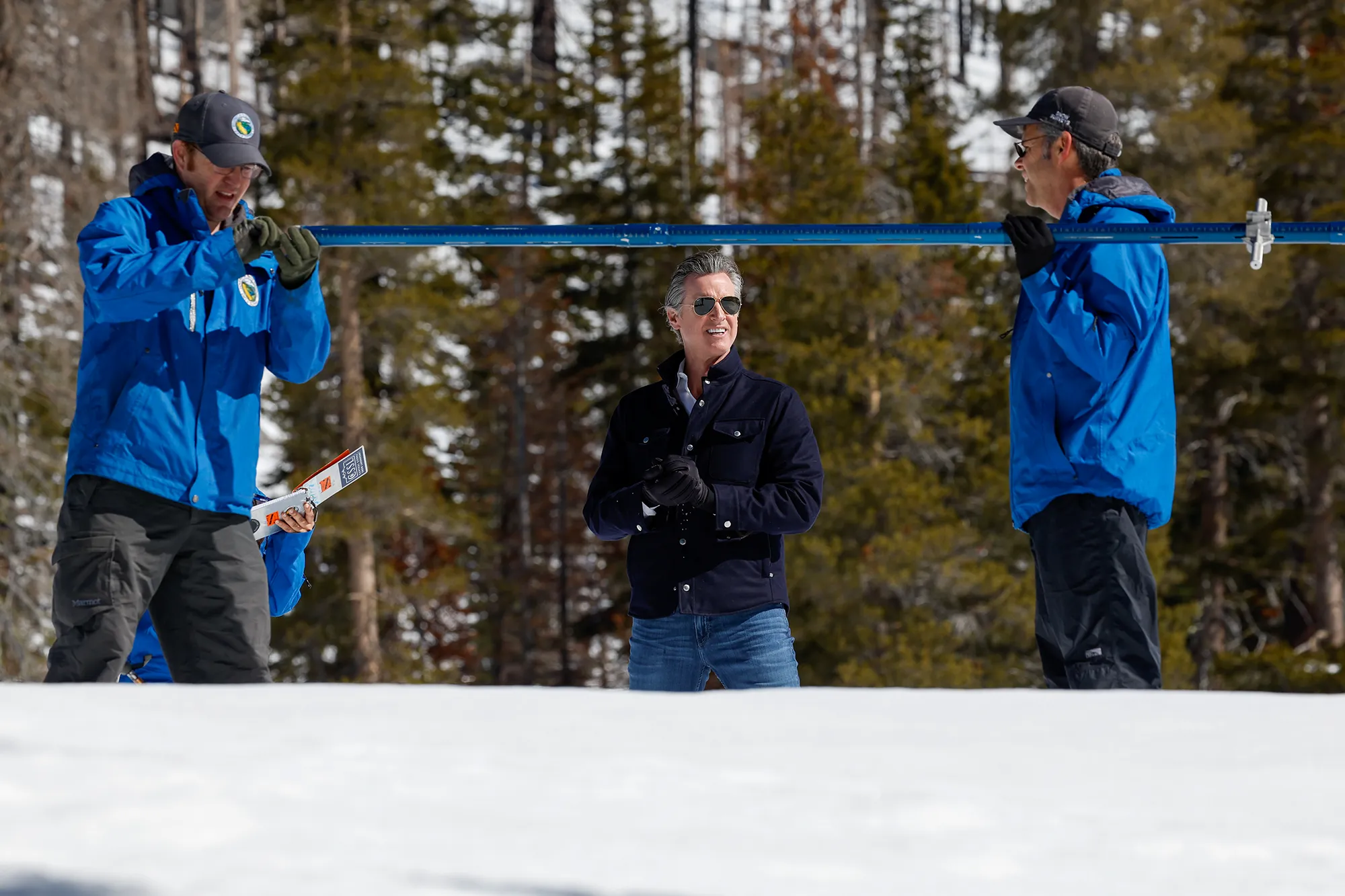
cover photo: Gov. Gavin Newsom watches as water engineers conduct the fourth media snow survey of the 2024 season at Phillips Station in the Sierra Nevada on April 2, 2024. Photo by Fred Greaves, California Department of Water Resources
 BY DAN WALTERS
APRIL 4, 2024
IN SUMMARY
California’s water supply is the healthiest it’s been this century thanks to two consecutive wet winters, but the state’s water interests continue jousting over priorities.
California’s major reservoirs are nearly full thanks to two wet winters, the Sierra snowpack is deeper than usual and the state is likely to receive even more rain and snow this spring.
After years of drought, California’s water supply is the healthiest it’s been in the 21st century. Nevertheless, the state’s age-old jousting over water use priorities continues and may become more intense as climate change affects the amount of water available.
On Tuesday, Gov. Gavin Newsom strapped on snowshoes to accompany state water officials as they measured the Sierra snowpack near Lake Tahoe and declared that it’s well over 100% of average.
The event was streamed online and Newsom used it to warn Californians that the state’s water future is uncertain and unveil an update of the state’s master water plan.
“You can take a deep breath this year, but don’t quadruple the amount of time in your shower,” Newsom advised, “then consider that this time next year, we may be at a different place.”
The water plan must be revised every five years and the new version dwells on “resilience” – making the water systems less vulnerable to climate change – and “equity.” It notes that “for more than 95 percent of Californians, safe, reliable, and affordable water is perceived to be a daily guarantee, but for approximately 1 million Californians, there is a persistent struggle to access water fit for human consumption.”
“These extremes are becoming the new reality, and that new reality requires a new approach,” Newsom said, adding, “I’ll remind all of you the water system in California was designed for a world that no longer exists.”
The updated plan describes itself as a “call to action, an all-hands-on-deck endeavor, in which everyone has a role – state agencies and departments with water, regulatory, and climate responsibilities; regional water and resource managers and stewards at every scale across water sectors; and individual Californians.”
It assumes that California will build two major projects: the Sites Reservoir on the west side of the Sacramento Valley to bank 1.5 million acre-feet of water during high precipitation years, and a 45-mile-long tunnel that would carry water from the Sacramento River to the head of the California Aqueduct near Tracy, bypassing the Sacramento-San Joaquin Delta.
“We’re seeing real progress,” Newsom said of the $16 billion project. “My goal is to get that permitted by the time you kick me out.” Newsom described it as “foundational (and) critical if we’re going to address the issue of climate change. It is a climate project. It is one of the most important projects this state can advance.”
Environmental groups contend that the tunnel would deprive the Delta of flows needed to maintain water quality for wildlife. Its future is linked to persuading – or compelling – farmers to reduce their diversions from the San Joaquin River and its tributaries, thereby allowing more water to flow through the Delta.
Environmentalists are pressing the state Water Resources Control Board to mandate reductions by updating Delta water quality standards, but that effort collides with historic water rights. Newsom wants diversions to be reduced through “voluntary agreements” rather than by decrees that would lead to legal battles.
The new water plan dances around the issue, endorsing the concept of voluntary agreements but declaring that the water board needs “increased capacity to halt water diversions when the flows in streams diminish (and) modernize the water rights system in a manner that respects water right priorities and aligns with current public values and needs.”
Within those vague words lies what could be a monumental battle.

Dan Walters
OPINION COLUMNIST
Dan Walters has been a journalist for more than 60 years, spending all but a few of those years working for California newspapers. He began his professional career in 1960, at age 16, at the Humboldt Times… More by Dan Walters
- CALFIRE SISKIYOU UNIT HAND CREW SELECTED FOR BLUE RIBBON AWARD
- 10th DAA selects Kenny Elwood for 2026 Golden Pass
- FICTITIOUS BUSINESS NAME STATEMENT: Carson’s Window Coverings & More
- Traffic Stop in Siskiyou County Leads to $1.9 Million Cocaine Seizure, Driver Arrested
- F-35A Lightning II Jets from Luke AFB Arrive for Two-Week Training at Kingsley Field