
By Mark Slack
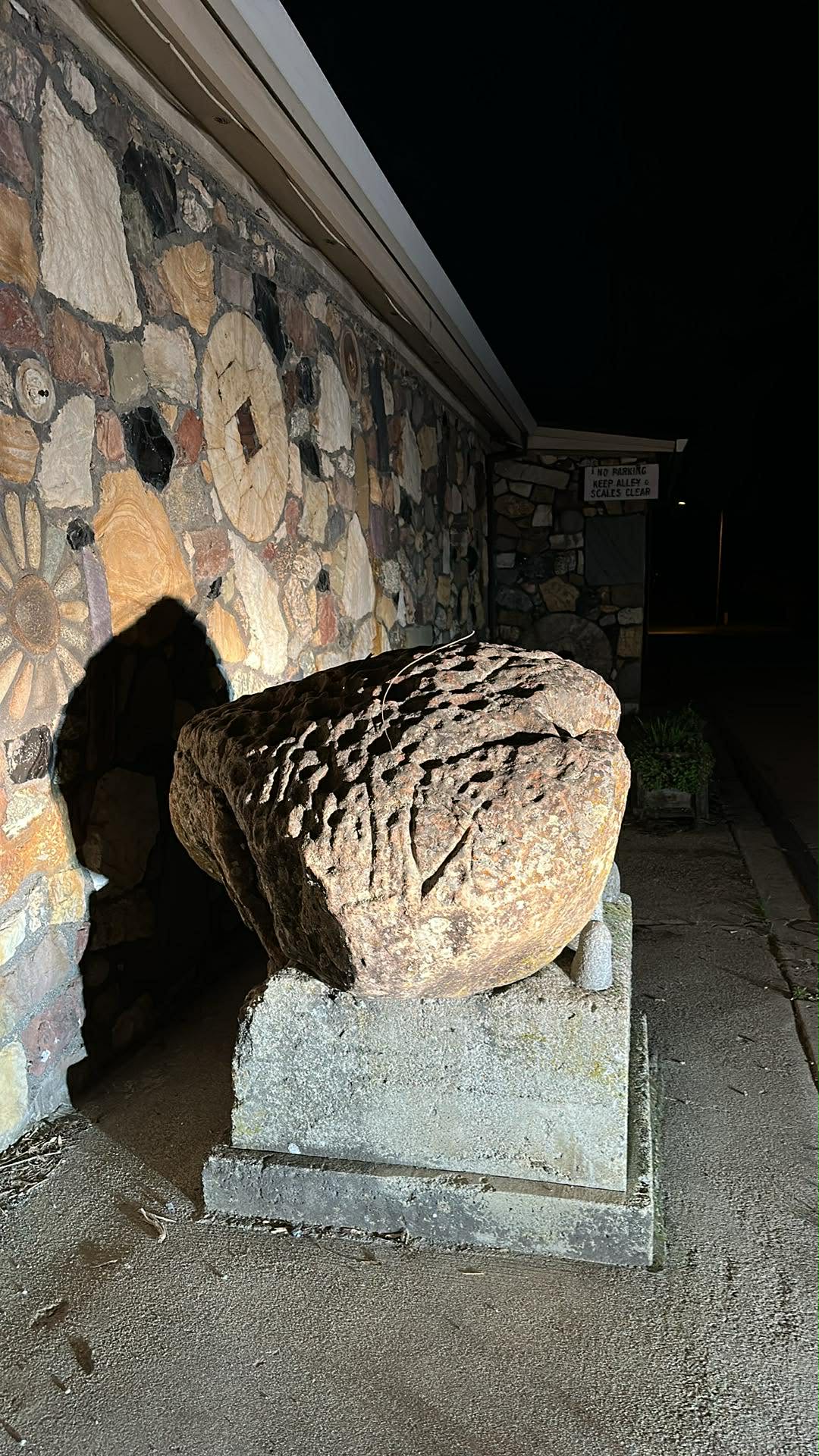
FORT JONES — A two-ton soapstone boulder that has found a resting place next to the museum along Main Street in Fort Jones has drawn attention lately when Karuk Indians have questioned rightful ownership of the rock.
Karuk spokesman Paul Gary Beck has enlisted the help of District Five Supervisor George Thackery in sorting out some of the history and background of the rock.
It seems that the boulder has been at its present location next to the museum since about 1947 when it was unearthed during road construction near Gottville which is just off Hwy. 96 north of here. According to Thackery interest was high at the Fort Jones Museum at that time and that is how it came to be brought here.
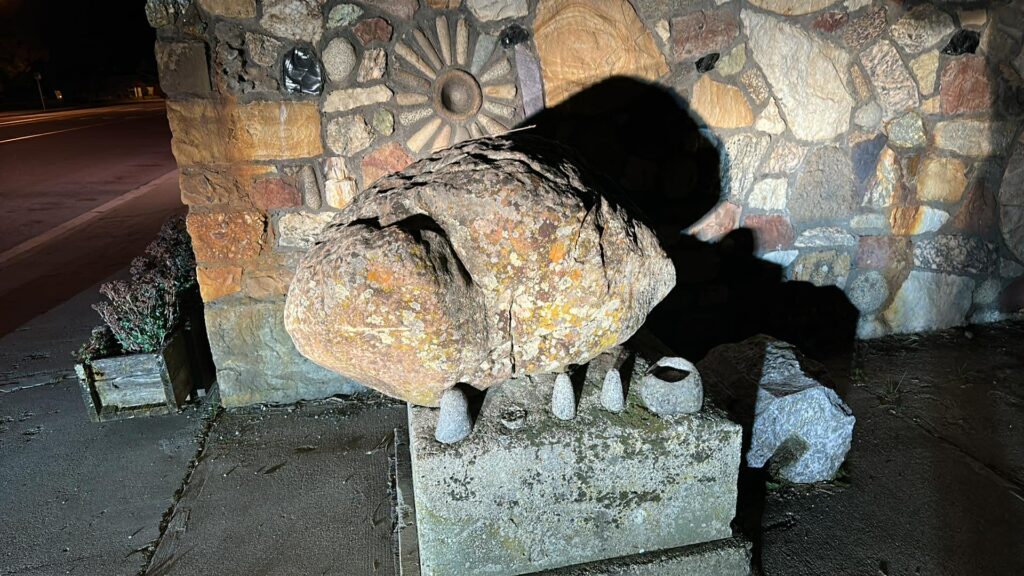
In the course of Thackery’s research he discovered that the rock was in fact not dug up in Karuk aboriginal territory, but rather, was found in Shasta Indian territory. Karuk Territory lay more to the west in the Happy Camp area with a belt of neutral ground in the area of Seiad Valley, with the Shasta tribes to the east of that; it was in this eastern area that the Rain Rock was unearthed.
A historian by the name of Robert Heizer wrote a report on the Rain Rock some time ago. In that report he relates an account of some of the past history of the rock given by a Shasta Indian:
“The rock had been covered for many years, until 1889,” the Indian said, “that year the salmon run had been extremely late due to deficient rain and low water in the Klamath River.” The Indian went on to say, “A very great rain followed after the rock was uncovered, and the rock was then covered up again until the highway crew dug it up again some 59 years later.”
Heizer explained in his research how the rock was used.
“If the series of long straight parallel grooves were scratched snow would fall, and to stop a snowstorm a scratch was made at right angles to the parallel grooves. The shallow conical pits were made to produce wind and rain, and the rock was covered to stop the rain.”
A clipping from the San Francisco Chronicle, written by Robert O’Brien and dated August 9, 1948, seems to indicate that the Rain Rock had become well-known shortly after coming to Fort Jones.
“It was not long before ranchers in Scott Valley began to notice peculiarities in the weather. Little by little they began to wonder if the Rain Rock was responsible. Wondering if, in fact, the Rain Rock was causing the capricious weather, (supervisor) Davidson took a Quartz Valley brave aside and asked his opinion.
“‘Keep the rock covered,’ warned the Indian, ‘or it will rain and snow all summer.’”
For a while Davidson regarded this as idle superstition. But totally irrational behavior on the part of the weather last winter — rain when there should have been snow, snow when there should have been rain, sleet when there should have been clear weather and clear weather when it should have stormed — gave him cause to ponder the Indian’s remark more seriously.
In the middle of May, a howling snowstorm struck Scott Valley. Not long after that, a wholly unexpected downpour rained out one night of the annual Siskiyou County Sheriff’s Posse rodeo. At that point Davidson decided that the Rain Rock had plenty of medicine. The next day they covered it with canvas.
Since then, the weather and Scott Valley have got along pretty well together, but Davidson swears that if he left the tarpaulin off for one night, anything, perhaps even a flood, might happen. Once he uncovered it to oblige a friend whose irrigation ditches were running dry. It was three days before he stopped raining.
Beyond the borders of Siskiyou County, the fame of the Rain Rock spread. The Oroville Chamber of Commerce, desperately hoping for fair skies over the Fourth of July weekend for their centennial celebration, wrote to the Supervisors asking if they would please see to it that the Rain Rock was covered on July 3, 4 and 5.
“Unless a dire lack of irrigation water arises in Siskiyou County or additional snow is needed for summer skiing on Mt. Shasta, we shall accede to your request that the Rain Rock be covered during your celebration,” replied the supervisors.
Officials of the Sacramento State Fair filed a similar request; and when I was there, toward the end of June, the following copy of a Western Union telegram was tacked to the village bulletin board:
“New York Boxing Commission, Yankee Stadium, New York City — Proceed with Louis–Walcott title bout. We have the Rain Rock covered. (signed) Chamber of Commerce, Fort Jones, Calif.”
This assurance was considered necessary, because someone had accidentally taken off the tarpaulin and left it off for two nights, and of course, it rained in New York both evenings and the fight had to be postponed.
The next day when it was discovered what had happened, the Rain Rock was hastily covered again, and the telegram was dispatched.
The third night, as you remember, the fight went off as scheduled.
From the Pioneer Press archives (January 16, 1985).