Home / Siskiyou News / Mt. Shasta’s Ups and Downs

Mt. Shasta’s Ups and Downs

We drive along the northern base of Mt. Shasta along scenic Highway 97.  My geologist friend and I are headed to where Whitney Creek crosses the highway and we pull off at that location.  My pardner has been keeping an eye on this spot for decades.  It is a place where exciting things can happen.

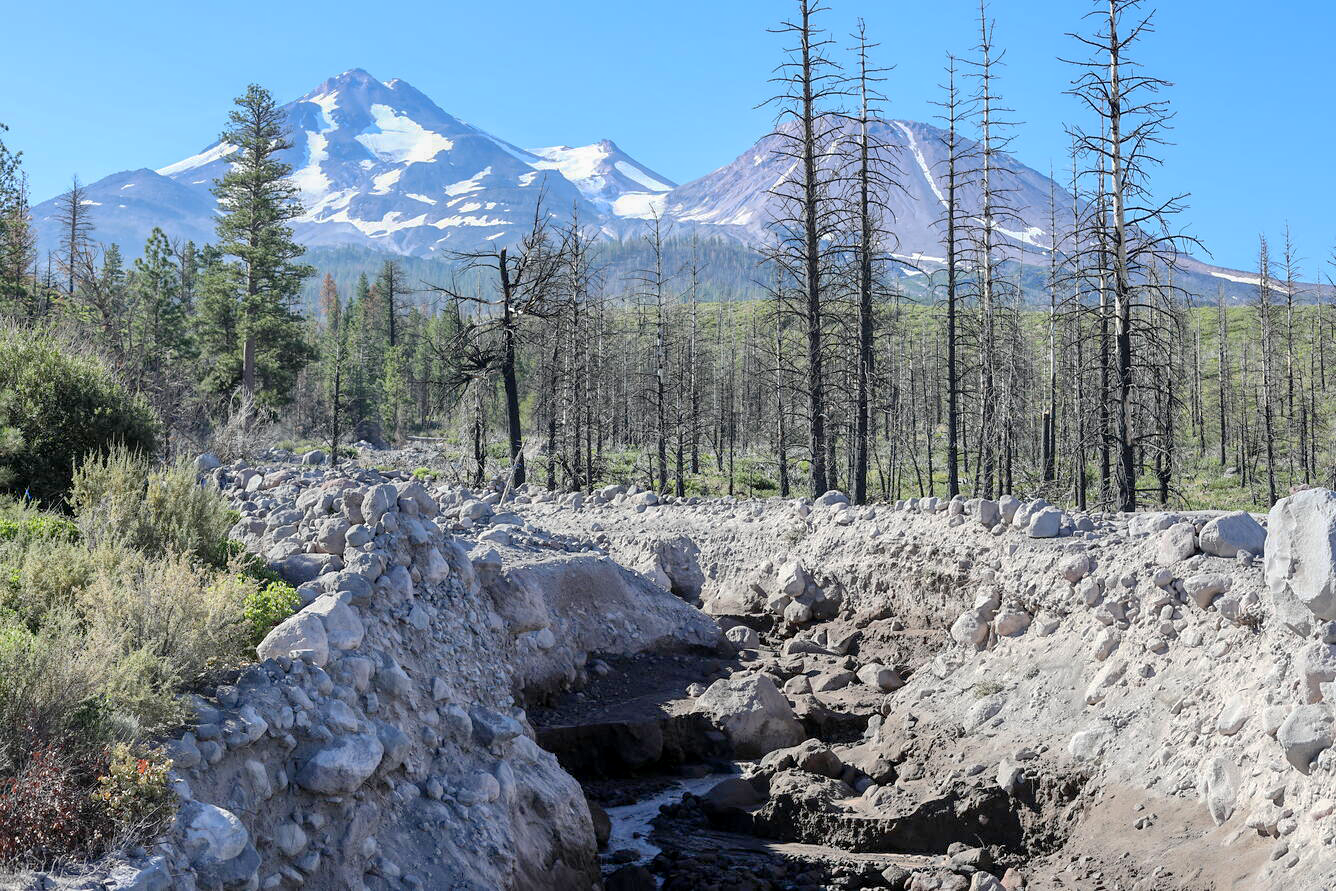
Here, irregular and difficult-to-predict events sometimes occur at any time during summer—usually during drought years.  Whitney Glacier, high on the northern slope of the volcano and the largest chunk of ice in our state, sometimes discharges a large amount of meltwater.  As the water flows down the canyon, it mixes with ash, mud, rocks and trees to form a mushy concrete-like mass.  Oftentimes the debris gets hung up, forms blockages, then jumps from one channel to other nearby gullies.  The flow has much force and has historically washed-out roads and the railroad.  Scars high up on trees near the channels are interesting artifacts of these events.

As I ponder this phenomenon, and ask my friend about the flooding process, it is clear that the Whitney Creek floods are eating away at our tall volcano and depositing the material on the flats below.  The same thing happens elsewhere on the mountain—in canyons along the old Ski Bowl road and most notably along Mud and Ash Creeks, near McCloud.

Mt. Shasta from Hwy 97 (j.a.martin Oct. 2021)

 From Highway 97 we look toward the north, along the length of Shasta Valley and the bumps and humps that protrude above the flats.  My friend talks about these hills, that for years were believed to be products of small volcanic eruptions.  Now, he states that there is a new theory, that the north side of Mt. Shasta, many years ago, collapsed!  The debris traveled many miles toward the north, as far as the Klamath River, near Hornbrook!

We eat our lunch and enjoy the view of the Cascade Mountains to the east and Klamath Mountains to the west—areas with totally different geologic histories.  Volcanoes to the east, islands and ocean bottom debris crammed onto the continent from the west.  Behind us, back on Mt. Shasta, we ponder the ridges and bumps protruding from its slopes.  Each of these represent a time when magma burst through the skin of the mountain, again and again, covering whatever existed there previously.  Sometimes, it oozed out, other times it flowed out in large, viscous amounts many feet deep.  Caves exist where we can see how the lava flowed subsurface after the crust cooled.  Sometimes cinders and ash burst out, carried about by the wind.

Our lunch was finished and I had asked my friend all the questions I had stored up for the outing.  I could tell that he was getting weary of my mosquito-like irritations, but, as always, he patiently explained the difficult concepts in ways I could almost understand.  My problem, like most non-geologists, is having difficulty grabbing onto the concept of immense amounts of time, and what can happen if enough time takes place.  Another problem all of us regular people have is to assume that the conditions we live in, what we see and experience each day, is what is normal and what has existed forever.  Geologists know better.  They are schooled in the concept that the earth is often quiet—until it does something exciting and special.  Huge amounts of lava can break through a mountain and travel many miles.  Earthquakes can crack open awesome chunks of the Earth’s crust.  Entire volcanoes can collapse with the debris transported, riding the cushion of compressed air, many miles without breaking up the large blocks of rock.  All of these things are hard to fathom if we believe the earth is stable and consistent.  For most of us it is easiest and most comforting to believe in a calm and consistent world—even if that concept is deeply flawed.

We got in our vehicle and head back toward home.  Of course, my mind is not content with wondering about what has happened in the past.  How about the future?  I ask my friend what he thinks.  He patiently responds in his trained manner–after all, during his career he constantly responded to questions about the future.  “Amazing and tremendous things have happened in the past,” he began. “Geologists try to figure out, sometimes with very little information, what has occurred.  But, we are constantly getting new ways to understand what has happened.  We also have a pretty good idea of how long ago events occurred.”  He paused, seeming to ponder how to complete his answer.

He shrugged and continued: “The best I can say is that whatever happened in the past, can and probably will happen again.  The mystery is ‘when’.  I can’t give you any definite answers to that question.”  We continue winding down through the lava fields and juniper forests and reached the bumps that had slid away from Mt. Shasta. We cross the irrigated fields, understanding that all of this could, or will, be covered again, and that our volcano will continue to build upon itself, taller and more massive.  He paused, then added a final thought—“I just hope that I’m here to see it.”

Mike Grifantini has degrees in Wildlife Biology and Forest Ecology.  He worked for timber management companies, the U.S. Forest Service and consulting firms.  He was privileged to have made a living walking the hills, looking for rare plants and animals and having picnic lunches in the woods.  Of course, there were reports to write and meetings to attend that muddled the otherwise perfect times.


Tagged:

Leave a Reply

Your email address will not be published. Required fields are marked *