Home / Siskiyou News / NEW series of nature-related articles: Owl Thoughts

NEW series of nature-related articles: Owl Thoughts

Publishers Note– I am so grateful for local voices:
a new series of nature-related articles, regarding topics that have been on our minds

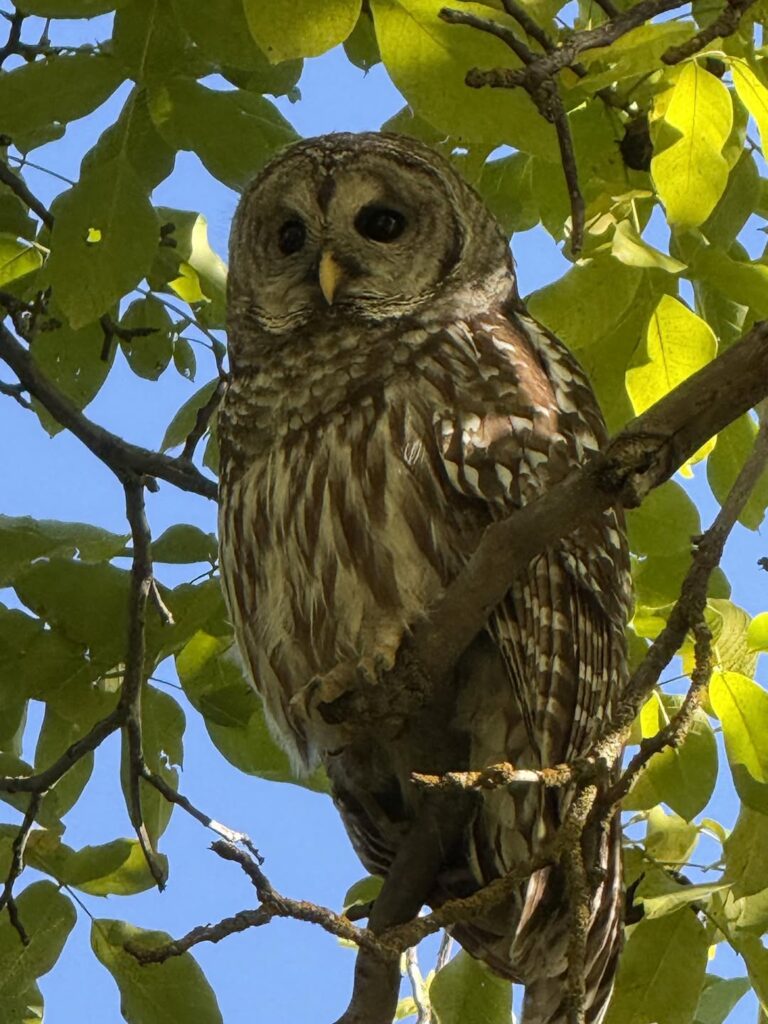
Barred Owl in Yreka Oct. 18th 2025 (courtesy of Carolyn Anderson)

โ€œCome over right now!  The owl is back!โ€  The urgent call came out of the blue.  Previously my friend and I had talked about owls and he had mentioned that one occasionally roosted during daytime in his backyard.  โ€œGive me a call the next time you see it,โ€ I requested.  Months later his call came.

It was a beautiful barred owl.  Its large eyes peered at us human voyeurs–occasionally craning its neck to track the housecat meandering across the lawn below.

The species was not new to me.  While working in coastal Oregon I was on the lookout for them while doing studies of spotted owls.  At that time, three decades ago, the barred owl was spreading west from its traditional home in the woods of central and eastern North America.  Perhaps logging, tree planting or wildfire had changed conditions in Canada, allowing the species to expand into Pacific Northwestern forests that had previously only supported spotted owls.  

At the same time the barred owl was moving into the West its cousin the spotted owl was making news.  In 1990 it was given legal protection under the Endangered Species Act, which resulted in more preservation of old forests.  The spotted owl was touted as the ultimate โ€œold-growth forest dependentโ€ species, even though it was sometimes found in younger forests. Federal agencies believed that by protecting areas with old trees the spotted owl would be preserved.  These forest preservation efforts resulted in a drastic reduction in timber harvest, which led to lost jobs and social disruptions in many rural western communities.

The barred and spotted owls are close relatives and very similar in appearance, although the barred owl is larger and more aggressive.  Sometimes they kill spotted owls or interbreed with them.  The barred owlโ€™s movement into western forests is now considered a major factor responsible for the continuing decline of spotted owl populations.  The federal government has responded with a program to kill many of the invaders.

As I watched the beautiful backyard bird I pondered the philosophical dilemma that the barred owl and spotted owl present.  While a working biologist I supported the wellbeing of all fish and wildlife and was never comfortable with tradeoffs.  In the case of these two owl species, our government determined that the spotted owl is more important than its cousin.  Therefore, considerable funds will be spent to kill the less important species while logging and milling jobs will be impacted and rural communities will take financial hits in order to protect the more important species.  I would find it very difficult to make these God-like decisions.

My mind wanders to other situations where the wellbeing of species causes conflict.  One example is at the locks of Seattleโ€™s Lake Washington, where seals and sea lions trap and kill salmon that have no escape routes!  Or, the situation where great white sharks along the Pacific Coast have increased in population following protection measures but the frequency of shark attacks on otters has increased!  For each species involved, the government had previously enacted regulations to help them thrive.  But, in situations where one species is affecting another, which is more important?  

Society faces the question of the relative value of species.  Are great white sharks of higher value than sea otter?  Are sea lions more important than salmon?  How about spotted owl versus barred owl?  Humans are proud of their problem-solving ability, or perhaps their ability to convince themselves that they have solved problems.  This has led to our willingness to pick winners and losers.

My mind is simple and I am not the best problem solver.  I only know a few things for certain: that nature is constantly changing and that animals will do anything they can to survive. For predators, that means killing and feeding upon other animals. 

Being retired, I now sit back and watch the gyrations society goes through trying to โ€œdo what is best for natureโ€.   Hopefully, society knows better than I.  Now, I am satisfied to watch these animals and thrill at their beauty and their will to survive. 


Siskiyou News welcomes open letters from readers on issues that impact our county or your community. Together, our voices can provide valuable information and express our appreciation for well-executed jobs, as well as offer words of thanks and encouragement. Your thoughts are welcome, regardless of your literary skills. (https://www.siskiyou.news/upload-news/)


Tagged:

Leave a Reply

Your email address will not be published. Required fields are marked *