

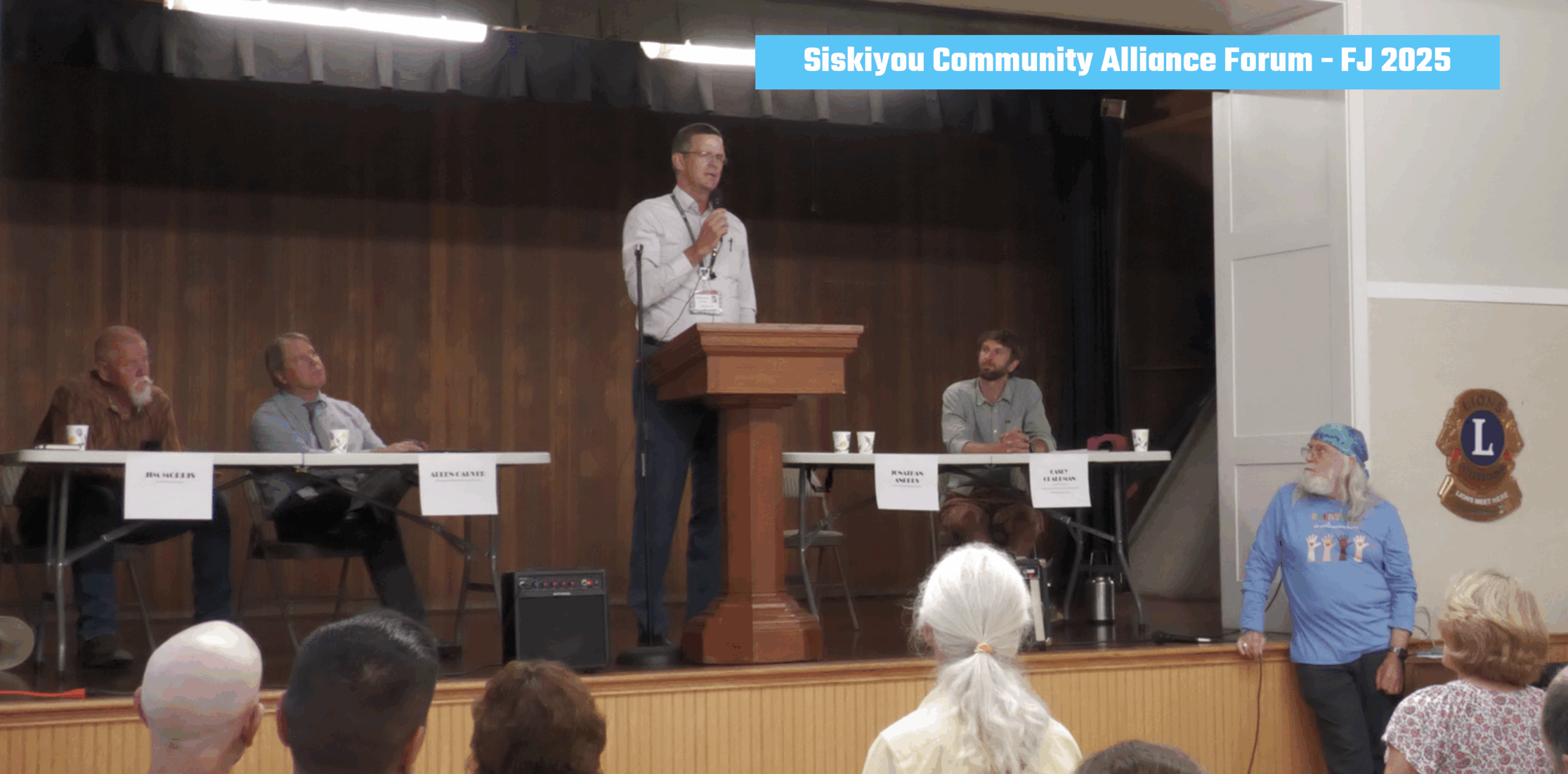
Healthcare, education, recreation, and agriculture sectors outline impacts of federal and state budget changes
FORT JONES — Local leaders gathered Thursday evening to outline how recent federal and state funding changes are affecting essential services in Siskiyou County, detailing significant financial pressures facing key institutions.
The Siskiyou Community Alliance hosted its second informational forum at a packed Fort Jones venue, bringing together representatives from healthcare, education, recreation, and agriculture to discuss real-world impacts of legislative changes on their operations.
Fairchild Medical Center Faces $1 Million Annual Loss
Jonathan Andrus, Fairchild’s President and CEO, reported the hospital will lose over $1 million annually due to a 4% reduction in Medicare reimbursements starting October 1. The cuts come as Fairchild undertakes its largest expansion since 1997 — a new 25,000-square-foot facility that will nearly triple emergency department space.
“Seventy-five percent of my patients are either Medicare or Medicaid,” Andrus explained. “We’re going to have to figure out in 2026 how to accommodate that kind of reduction.”
Andrus also highlighted state-imposed challenges, including Governor Newsom’s Office of Healthcare Affordability limiting hospital charge increases to 3.5% despite drug costs rising 10% and labor costs increasing 6%. This restriction could cost Fairchild $5-7 million in gross revenue.
Despite the financial pressures, Andrus emphasized the hospital’s commitment to maintaining services and recently welcomed two new internal medicine doctors fresh out of residency.
County Schools Face Declining Enrollment, Funding Cuts
Alan Carver, County Superintendent of Schools, reported that student enrollment has dropped by more than 5,600 students over the past decade — representing 10-12% of the county’s student population. He attributes much of the decline to homes lost in fires that were never rebuilt.
“When 250 homes burn down, only 50-70 are typically rebuilt,” Carver explained.
The county’s education system faces potential losses of $1.9 million in forest reserve funding for schools and approximately $2.76 million in federal Title funding. Early Head Start programs were particularly affected when federal grant funding was frozen, forcing temporary staff layoffs until funding was restored in late July — though 25% of staff was permanently lost.
Avalanche Center Scales Back Operations
Casey Glaubman, Executive Director of the Friends of the Mount Shasta Avalanche Center and Mount Shasta City Council member, described how federal grant funding freezes affected operations, forcing staff reductions. Cuts to NOAA weather forecasting services have already impacted weather discussions that forecasters rely on for avalanche predictions.
Road closures to Bunny Flat last winter — lasting 50-60 days — resulted in economic losses between $250,000 to $1 million for Mount Shasta alone, according to an independent economic impact study. The closures affected a growing winter tourism economy that has expanded significantly since COVID-19.
“Mount Shasta used to be significantly more summer-based tourism,” Glaubman noted. “Winter recreation and winter tourism has definitely increased over the last few years.”
Scott Valley Rancher Reports Agriculture Challenges
Jim Morris, a sixth-generation Scott Valley rancher, reported minimal direct federal funding impacts on his operation, but significant challenges from high input costs — including electricity, equipment, fertilizer, and seed — while market prices remain low for most products except cattle.
Morris identified water regulations imposed by the state as agriculture’s biggest current challenge, more so than federal policy changes. He also noted the industry’s aging workforce problem, calling himself “a young guy in ag,” which he described as “a bad thing.”
Jim advocated for developing value-added processing facilities locally rather than exporting raw commodities. “We could clean seed, do processing here,” Morris said. “Take a crop from a lower value crop to a higher value product when it leaves the valley, and employ more people.”
He explained how hay exports to China work economically: shipping containers arrive at West Coast ports full of goods, and it’s cost-effective to fill the empty containers with pressed hay for the return trip to China rather than ship them back empty.
Morris said agriculture has become “way too good” at production, leading to oversupplied markets and depressed prices.
Forum Draws Community Engagement
The forum, livestreamed on YouTube and to several FB pages, a room full of attendees engaged in a question-and-answer session covering topics from healthcare access to agricultural labor impacts.
The grassroots Siskiyou Community Alliance plans to continue hosting these informational sessions. Their first forum was held in Gazelle in May.
“We want to see this arena provide good information, answer questions,” said Cate Olivilo, an SCA member who helped moderate the event.
Despite the challenges outlined, speakers emphasized their commitment to maintaining services and adapting to changing circumstances while continuing to serve their rural communities.
The Siskiyou Community Alliance encourages community feedback through surveys and maintains a newsletter for updates on future forums. Donations to support their work are welcomed as the grassroots organization operates without formal nonprofit status.
*no sound till 15:15 into the video. (Livestream issues)
- Writing Classes and Contests – John Sammon
- Loose Screws: Mount Shasta Leadership Shakeup Leaves Questions Unanswered
- Protecting Your Health During A Wildfire : What Northern California Residents Should Know
- State Water Board To Consider LOW-INTEREST LOAN For Quartz Valley Tribe Land Acquisition In Scott River Headwaters
- Obituary: Minnie “Bunny” Frederick