
Home / Short Stories / The Genius and the ‘Birdbrain’: Mozart’s Starling

The Genius and the ‘Birdbrain’: Mozart’s Starling

By Andrew Benson Brown

Many composers had pets, and most of them seem to have been dog people. Wagner had about a dozen over the course of his life. Edward Elgar also had several, and even alludes to a friend’s bulldog in No. XI of his “Enigma” variations. Beethoven formed a bond with the dog of one of this pupils he was in love with. When she rejected his marriage proposal, the canine, Gigon, followed him around that evening, comforting his wounded heart.

Sir Edward Elgar lived in Hereford, England, between 1904 and 1911. One of his “Enigma” variations was inspired by a bulldog named Dan falling into the River Wye at Hereford, and the dog is honored with a wooden statue beside the river. (Billabong25/CC0)

Mozart was a great animal lover. Like others, he had a fondness for man’s best friend, as well as cats. Above all other species, though, he enjoyed birds, and kept several canaries. One of his feathered friends has even gone down in history as the most famous animal to ever influence a composer.

A Miraculous Coincidence

One day in 1784, Mozart was walking on the streets of Vienna. While passing a pet shop, he heard a familiar tune. It was a bird singing the Allegretto theme from his G major piano concerto, K. 453.

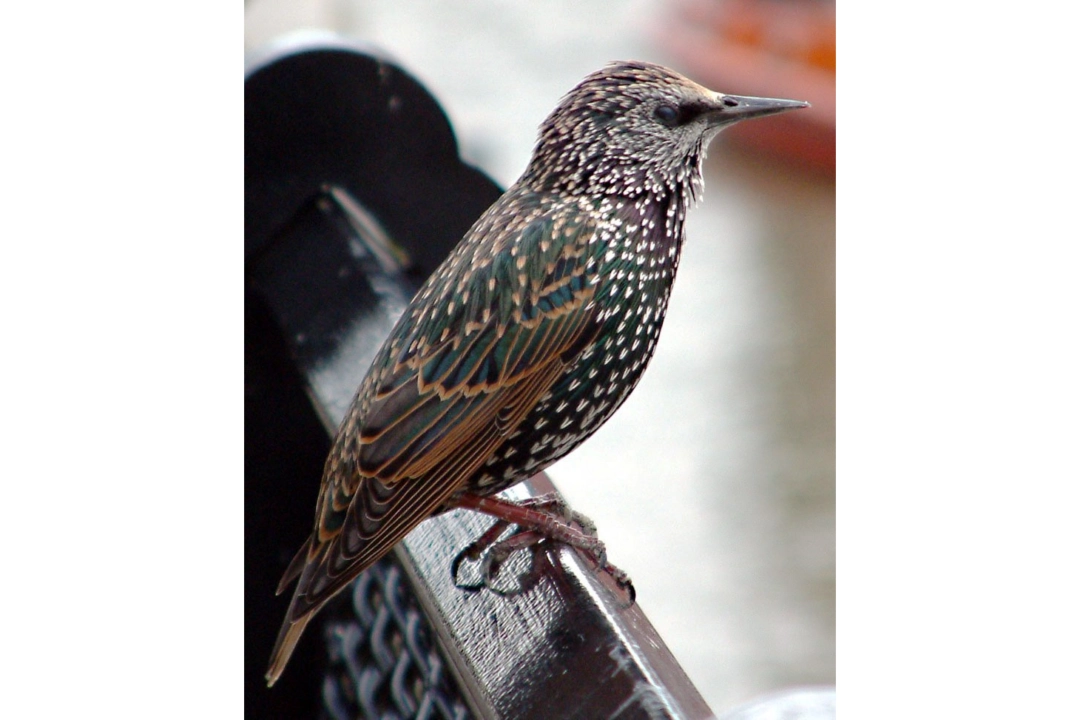
Mozart followed the song, walked inside the shop, and peered into a cage. There was a starling staring back at him. He was shocked as it repeated the tune he had written over a month ago, and bought it for 34 kreuzer. Later that day, he transcribed the bird’s song in a notebook under the price he paid for it. The tune was almost the same, except that the last two G notes became G-sharps. He commented on the starling’s variation with, “Das war schรถn!” (“That was wonderful!”).

Book cover for Lyanda Lynn Haupt’s “Mozart’s Starling.”

Starlings are excellent at mimicry, being able to imitate musical instruments, the human voice, and many other sounds. But Mozart had not yet performed the concerto in public. One might believe that Mozart had taken his concerto’s melody from the bird, except that he had catalogued his concerto on April 12, and it was now May 27.

Still, many people have thought the starling taught Mozart the tune. As seasoned birder and naturalist Lyanda Haupt writes in “Mozart’s Starling,” this view “appears in print with some frequency.” There is no evidence to support the claim, however, since the prior date of the catalogued concerto is verifiably documented.

Others have speculated that Mozart whistled the tune to the bird before he bought it. But if that’s the case, why did he hear the song beforehand and follow the melody to its source inside the shop? Lacking other sufficient explanations, the starling’s mimicry seems to have been pure coincidence.

Two Kindred Spirits

After this amazing event, Mozart took the bird home with him. He called it Vogel Staar, German for “starling bird.” Whether this was intended as a name or merely as a description, the feathered friend was a constant companion for the next few years.

Pets often take on the personalities of their owners, and the starling possessed many characteristics of Mozart himself. As Haupt noted in an NPR interview about her book, “Mozart himself was a great mimic. โ€ฆ He could imitate any musical style. But he also liked to mimic people for fun, you know; at parties, he would mimic the emperor. So Mozart himself was very mischievous, very clever, with kind of an eccentric personality.”

A 1789 miniature of Mozart. (Public Domain)

Three years after bringing home the starling, on May 28, 1787, Mozart’s father died. While the son wrote a letter to a friend expressing his sorrow over Leopold’s passing, he did not attend the funeral. Salzburg was a good distance from Vienna and Mozart, apparently, did not have time to make the journey.

A week later, Vogel Staar died. Mozart buried it in his garden, held a ceremony with elegantly dressed friends, and wrote a 24-line elegy that he inscribed on the bird’s small tombstone, dated June 4, 1787. The opening lines from music critic Marcia Davenport’s translation read:

A little fool lies here
Whom I held dearโ€”
A starling in the prime
Of his brief time,
Whose doom it was to drain
Death’s bitter pain.

A Musical Joke

Ten days after the starling’s death, on June 14, Mozart entered a new piece in his catalogue of works: “A Musical Joke,” K. 522. A divertimento (a light composition for chamber orchestra) for two horns and string quartet, it contains musical errors such as repetitive phrases, inaccurate notation, illogical transitions, and reversals of correct harmonic order. The piece is a conscious attempt to poke fun at musical ineptitude.

According to scholars Meredith J. West and Andrew P. King in a 1990 article of American Scientist, this piece bears “the vocal autograph of a starling.” The illogical patchwork of “A Musical Joke” matches “the starlings’ intertwining of musical tunes.” The awkward sounds mirror the bird’s tendency “to whistle off-key or to fracture musical phrases at unexpected points.” The meandering quality of the piece “is characteristic of starling soliloquies,” and the abrupt ending also has the bird’s “signature.”

Beyond “A Musical Joke,” Vogel Staar may have influenced other works by Mozart. As Haupt observes: “An infinity of bird-like phrases visit his later work,” and the arias of his operatic heroes contain “bouts of starling-esque mischief.”

Haupt also speculates that the character of the bird-catcher Papageno in one of Mozart’s greatest operas, “The Magic Flute,” was inspired by none other than Vogel Staar. Papageno is, among other things, “charming, โ€ฆ strange, feathery, musically adept, unpredictable, troublesome yet delightful.” In all these qualities, Papageno was like Mozart’s starling (and Mozart himself). While there is no direct evidence for this connection, the idea is not implausible.

Emanuel Schikaneder as the first Papageno in Mozart’s “The Magic Flute.” (Public Domain)

Influence Takes Wing

Mozart’s starling exerts an unending fascination for fans of the composer. In addition to the authors already noted, the bird has inspired works of art and numerous children’s books.

In one of these, “Mozart Finds a Melody” by Stephen Costanza, the author puts an imaginative spin on the claim that the starling taught the melody to the composer. Here, Mozart is suffering from writer’s block when he hears the bird, which he already owns, sing out a tune. Then, as he is about to write it down, it flies out the window, prompting Mozart to go searching for it to finish the piece.

Although not strictly factual, this charming story is a delightful way to get young readers interested in classical music. Sometimes, it takes a birdbrain to unlock imagination.

EpochNewsWire


Leave a Reply

Your email address will not be published. Required fields are marked *