
Home / Yreka News / Sorting Through the Confusion: Yreka’s Dust Cloud Incident and Lingering Health Concerns

Sorting Through the Confusion: Yreka’s Dust Cloud Incident and Lingering Health Concerns

YREKA, Calif. โ€” As families flock to the Siskiyou Golden Fair for its second day of midway thrills and community cheer, a veil of uncertainty still shrouds the industrial accident that gripped Yreka just 48 hours earlier.

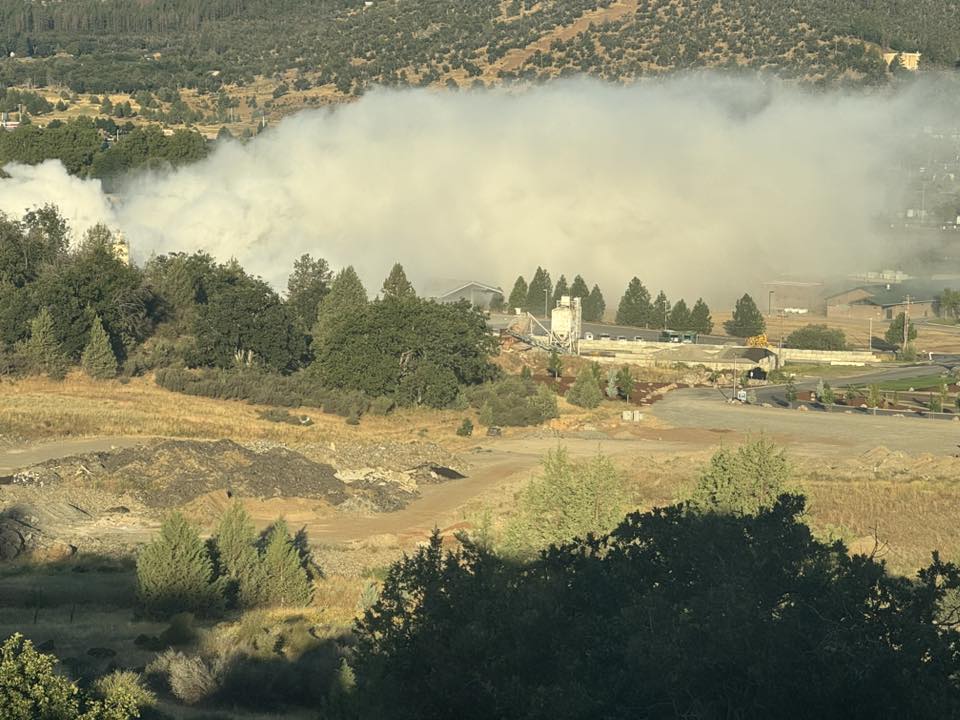
On August 5, an equipment malfunction at Mountain Ready Mixโ€”a concrete batch plant operated by Greg Gunlockโ€”unleashed a massive plume of caustic dust across the city, triggering a 1.5-hour shelter-in-place order and leaving residents scrambling indoors amid fears of airborne hazards. What emerged from my investigation reveals dangerous gaps in emergency response, health monitoring, and official transparency that should concern every Siskiyou County resident.

The Real Story Behind the Dust Cloud

Initially dismissed by some as routine construction dust, the material released was confirmed by Siskiyou County Air Pollution Control District specialist Klev Hegdal as “a ‘slag’ mixture of calcium oxide (quicklime) and quartz, finer than flour.” Despite the “slag” terminology, this was not steel production waste but industrial-grade quicklimeโ€”a highly caustic material that can cause chemical burns on contact with skin, eyes, and respiratory tissue.

The distinction matters. Calcium oxide’s caustic properties mean it reacts with moisture to create a high-pH base capable of inflicting serious injuries. Combined with crystalline silica (quartz), the mixture poses both immediate burn risks and long-term threats including silicosis, lung cancer, and COPDโ€”even from brief high-exposure events.

My initial suspicion pointed to fly ash, a common concrete additive, but a fellow batch plant operator revealed a critical context: fly ash supply is “dwindling nationwide, including in California, due to material shortages.” This explains why Mountain Ready Mix was likely storing massive quantities of bulk quicklime as a cement supplement.

Missing Health Protections

Here’s where the story gets alarming. Despite releasing tons of caustic dust over a populated area, no surface concentration testing was conducted to assess contamination on outdoor surfaces, playground equipment, vehicles, or other areas where secondary contact exposure could occur.

Rick Dean from emergency services acknowledged that “contact could cause burns” and advised keeping windows up when driving through affected areas. But when pressed about surface contamination checks, Dean admitted officials were unaware of any such testing.

Cliff Munson’s ground-level observations provide the clearest picture of the contamination pattern: the dust cloud “lingered and hovered in the area, moving its way over the top of the solar array, slowly making a loop to Oberlin and back over by the trailer park”โ€”potentially depositing caustic residue across a wide area that could cause burns hours or days after initial contact.

This oversight becomes even more troubling considering the timing. The Siskiyou Golden Fair opened August 6โ€”just one day after the incidentโ€”drawing thousands of attendees including children to outdoor venues potentially affected by dust fallout.

Fair CEO Clifford Munson provided a ground-level account of the morning’s chaos: “A crew of workers were actually working in the middle fairgrounds, finishing setting up picnic tables and putting covers on and wiping everything down when the alarm went out on people’s phones to shelter in place, sparking confusion. No one was aware of what was going on until someone pointed out the cement plant along the eastern end of the fairgroundsโ€”it looked like it had exploded.”

Munson described how the massive dust cloud “lingered and hovered in the area, moving over the top of the solar array, slowly making a loop to Oberlin and back over by the trailer park.” Crucially, he noted the cloud “never went directly over the fairgrounds” after the shelter-in-place order was lifted.

To their credit, fair workers took decontamination seriously despite the lack of official guidance: “They actually did wipe everything down again and double-checkโ€”there was nothing obvious discovered in their attempt to make sure the fair was ready for the week.”

But this responsible response happened without any official testing protocols or health department guidanceโ€”fair officials made contamination decisions based on visual inspection alone.

Communication Breakdown

The scale of confusion that morning becomes clear from Fair CEO Clifford Munson’s firsthand account. Workers were in the middle of the fairgrounds “finishing setting up picnic tables and putting covers on and wiping everything down” when emergency alerts suddenly appeared on their phones ordering them to shelter in place.

“No one was aware of what was going on until someone was able to point out that the cement plant along the eastern end of the fairgroundsโ€”it looked like it had exploded,” Munson explained. “There was great confusion as to what the cloud was, as it just tended to linger and hover in the area.”

The Sheriff’s 7 AM Facebook alert provided no context about the nature of the emergency, the affected area, or the durationโ€”leaving workers and residents to piece together what was happening as a massive dust cloud drifted overhead. Many residents I spoke with only learned about the incident hours later when news outlets began reporting, despite following the county’s official social media pages.

In a county split by Interstate 5โ€”a major corridor for hazardous materials transportโ€”relying on social media algorithms for emergency notifications is simply inadequate.

Meanwhile, my attempts to get basic information about the incident hit a wall of official silence:

  • No replies from Board of Supervisors Chair Nancie Ogren on dust composition and monitoring
  • No response from Air Quality Director Jim Smith on concentrations and fairground safety checks
  • Unanswered messages to Environmental Health officials, Dan Wessell (on vacation), Darin Weeks, and Mountain Ready Mix

The City of Yreka issued a press release touting “active management” with “no indication of long-term health impacts,” but specifics on air quality metrics, particle concentration levels, or surface contamination protocols remain glaringly absent.

The Broader Context

This incident exposes fundamental flaws in how rural counties handle industrial accidents. When workers at a major public venue can’t identify an industrial emergency happening at a neighboring facility without visual confirmation of an apparent “explosion,” it reveals dangerous gaps in emergency preparedness and inter-agency communication. Cal/OSHA opened an investigation but has released no findings. The incident hasn’t appeared on California’s official environmental incident reporting dashboard. Meanwhile, mainstream media echoes the “minimal threat” spin without examining the health protection gaps.

As an independent voice funded by my own resources and supporter aid, I’m dismayed at the institutional complacency. Siskiyou County sits at the crossroads of major transportation corridors, hosts multiple industrial facilities, and faces increasing wildfire risks that can mobilize stored toxins. We need emergency response systems that actually protect public health, not just manage public perception.

Observation that “it’s a great time for a little rain” to settle the dust highlights the ad hoc nature of the response. We shouldn’t rely on weather to clean up industrial accidents.

What Comes Next

Cal/OSHA’s investigation continues with little transparency. I’m still waiting for responses from the County Health Officer, Public Health Department, and Air Quality Director Jim Smith, who may be occupied with wildfire season monitoring across this vast agricultural county.

But the questions remain urgent: What protocols exist for surface contamination testing after caustic material releases? How do officials decide when public venues are safe to reopen? What long-term health monitoring will track potential silica exposure effects?

Siskiyou residents deserve answers, comprehensive testing protocols, and emergency systems that don’t depend on Facebook posts. In an era of increasing industrial activity and climate-driven disasters, half-measures aren’t enough.

Demand full reports. Demand testing. Demand accountability. Stay alertโ€”because in Siskiyou County, the next toxic cloud shouldn’t catch us off guard.


Jay A. Martin loves doing this for you, covering environmental health and government accountability for the good folks of Siskiyou. We will keep updating as official responses come in to this ongoing story.


Tagged:

Leave a Reply

Your email address will not be published. Required fields are marked *