

BY DAN WALTERS
CalMatters
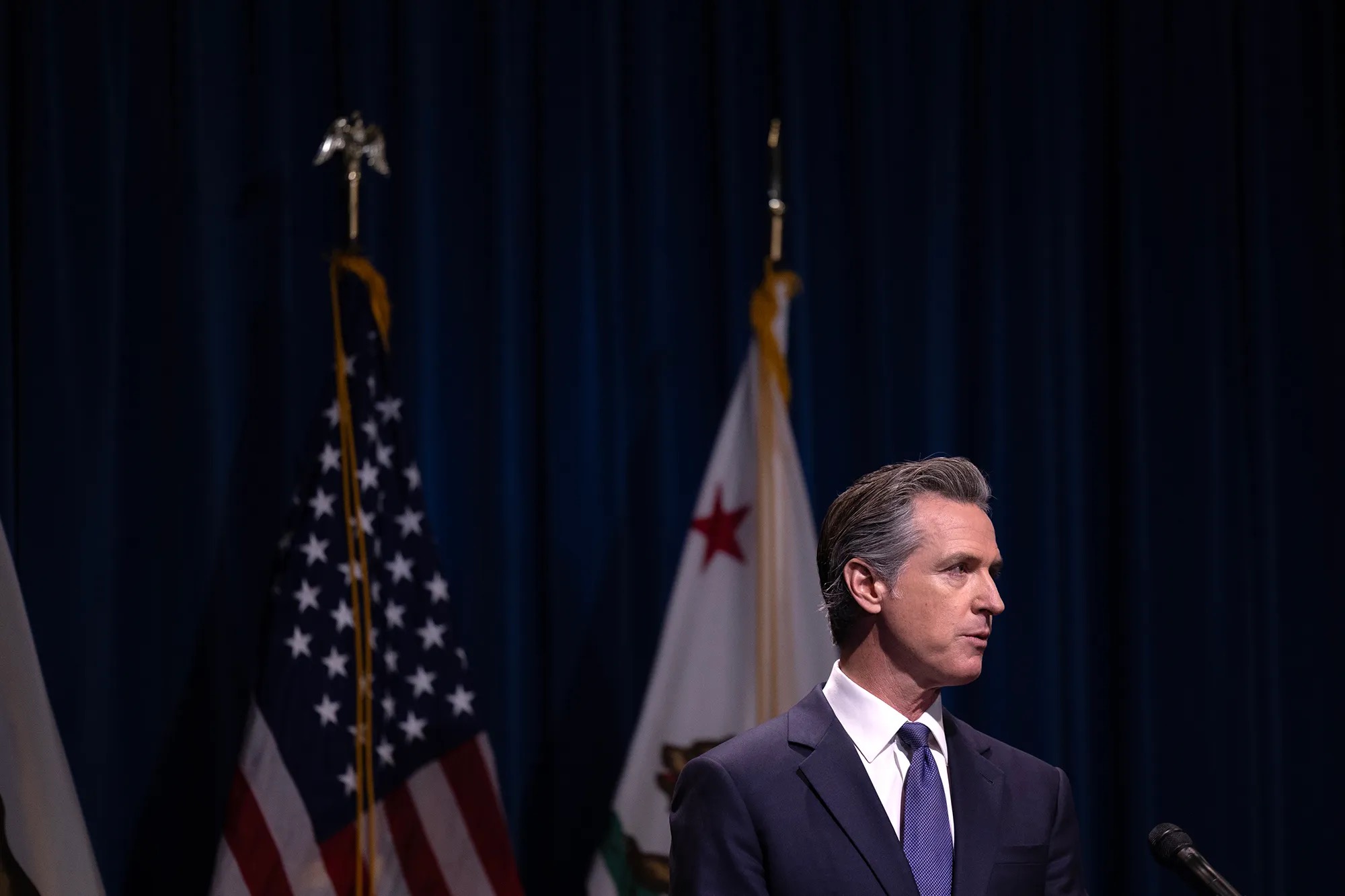
Cover photo: Gov. Gavin Newsom discusses his initial 2024-25 budget proposal at the Secretary of State Auditorium in Sacramento on Jan. 10, 2025. Photo by Miguel Gutierrez Jr., CalMatters
In summary
California faces the prospect of ongoing, multibillion-dollar gaps for the remainder of Gavin Newsom’s term as governor. Will he solve the underlying problems or leave them for his successor?
California governors tend to leave hefty budget deficits behind when they depart, forcing their successors to raise taxes, borrow money or make big spending cuts to maintain solvency.
It happened in 2003 when Democrat Gray Davis was recalled and Republican Arnold Schwarzenegger succeeded him, and again in 2011 when Schwarzenegger handed over the governorship to Democrat Jerry Brown, to cite two recent examples.
The current governor, Democrat Gavin Newsom, was spared when he assumed office in 2019. However, having increased spending by nearly 50% over the last five years, Newsom now faces not only a huge deficit – the exact size is subject to debate – but the prospect of multibillion-dollar shortfalls for the remainder of his governorship.
Late last year, the Legislature’s budget analyst, Gabe Petek, issued his annual report on the state’s fiscal situation, saying not only that state had a $68 billion current deficit due to revenues falling short of projections, but annual deficits in the $30 billion range for the next several years.
Last week, when Newsom proposed a 2024-25 budget, he pegged the deficit at $38 billion and proposed to cover it with a mixture of spending cuts and deferrals, loans from special funds, reserves and some accounting gimmicks.
Over the weekend, Petek reiterated his estimate of a larger deficit and once again told the Legislature that it should take a longer-range view – not only closing the current gap but addressing the structural deficit that lies ahead.
“Overall, the governor’s budget runs the risk of understating the degree of fiscal pressure facing the state in the future,” Petek said in a review of Newsom’s proposal. “The Legislature likely will face more difficult choices next year. To mitigate these challenges, we recommend the Legislature develop this year’s budget with a focus on future years.”
While Newsom and Petek’s disagreement is mostly due to revenue estimates and school finance obligations, they agree that the deficit isn’t a one-time problem, but rather an ongoing gap between likely revenues and spending already locked into law.

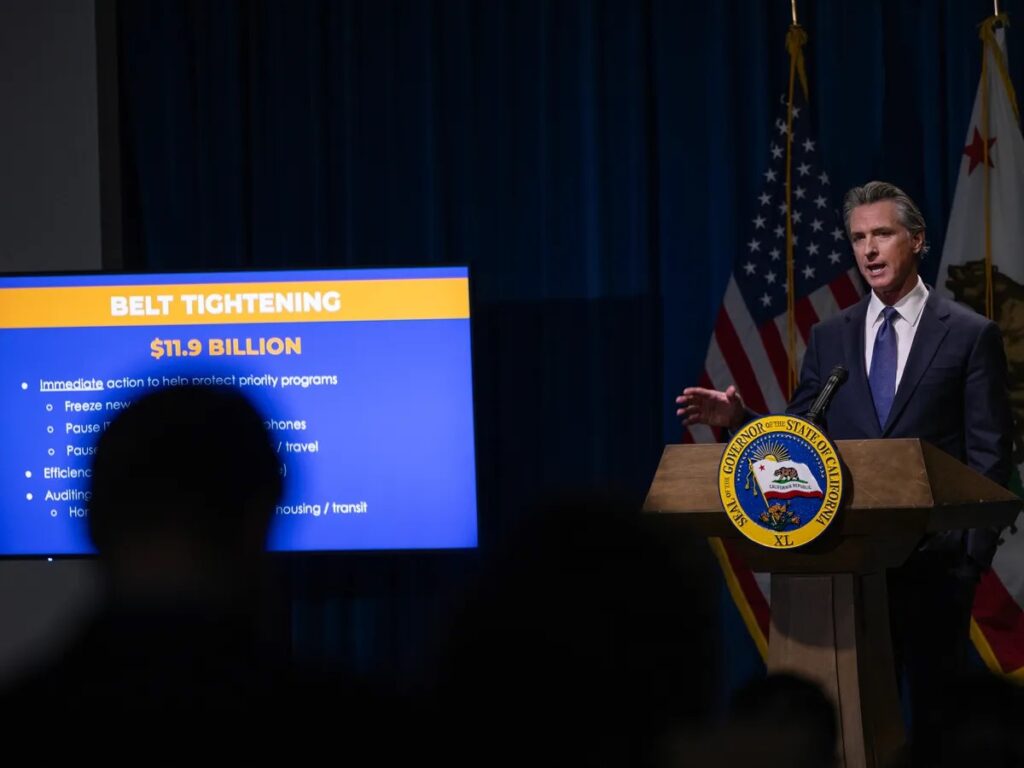
A little-noticed section of Newsom’s budget, projecting income and outgo through 2027-28, says it would be an eye-popping $81 billion out of balance by then, largely due to fairly stagnant revenues being outstripped by mandatory increases in spending for K-12 schools and community colleges, and complete exhaustion of reserves.
This gloomy fiscal outlook also assumes that the state won’t experience a recession in the next few years. Were that to occur, the annual deficits would surely be even larger.
The longer-term projections indicate that Newsom’s approach – papering over the current shortfall with actions that could worsen future problems – is very shortsighted, and Petek’s advice to legislators about focusing on the future is quite prudent.
However, Petek’s approach would require Newsom and a legislature dominated by Democrats to make some very difficult decisions, such as throttling back the extensive array of new and expanded social services they have enacted in recent years and/or raising taxes.
The difficulty is compounded by Newsom’s current obsession with building a national political profile, perhaps in preparation for a 2028 presidential run. He has been peddling the image of California as a state that is generous with benefits without increasing its already high level of taxation, specifically opposing those in his party who want to increase taxes on the wealthy or corporations.
The projections by Petek and Newsom’s own budget advisors of ever-increasing deficits undercut that image. Will Newsom bite the bullet or muddle through the next few years and dump a huge fiscal crisis on his successor?

Dan Walters OPINION COLUMNIST
Dan Walters has been a journalist for more than 60 years, spending all but a few of those years working for California newspapers. He began his professional career in 1960, at age 16, at the Humboldt Times… More by Dan Walters
Members make “it” possible.
- Rural County Representatives of California Opposes AT&T Petition that Threatens Universal Telephone Service ProtectionsPost Views: 11 If the FCC grants AT&T’s petition, the company could move forward with abandoning universal service obligations that millions of Californians rely on, particularly those living in rural communities. Broad coalition urges FCC to preserve California’s authority to protect access to reliable communications services for all residents SACRAMENTO, CA – The Rural County Representatives
- Obituary: Marjorie Elenore RuggPost Views: 8 Marjorie Eleanore Rugg (Kinkead) was born June 18, 1930, in Yreka, California. Her birth mother, Margaret A. Pope, died soon after giving birth to Marjorie. She lived with her grandparents, Newton and Phoebe Kinkead, until 1935, when her Father, Seymour Kinkead, and his wife, Ruby May, took her back to live with
- Only 16 of California’s 109 Federally Recognized Tribes Have Quantified Water Rights, PPIC Report FindsPost Views: 29 Negotiated settlements offer clearest path to certainty for Tribes and other water users A new report from the Public Policy Institute of California examines the complex and often poorly understood system of Tribal water rights across the state, finding that just 16 of the 109 federally recognized Tribes have had their federal
- With Water Board funding, tribe to regain nearly 40,000 acres of ancestral lands in Klamath River Basin Post Views: 160 Largest single land back deal will advance tribal water quality projects Source: State Water BoardJuly 24, 2026 SACRAMENTO –The State
- White House admits it used keywords to kill billions worth of California research grantsPost Views: 23 By Mikhail Zinshteyn, CalMatters This story was originally published by CalMatters. Sign up for their newsletters. Federal agencies that terminated more than a thousand research grants at the University of California last year admitted that they used keywords related to diversity, gender, vaccine hesitancy and COVID-19 to screen for projects that ran