

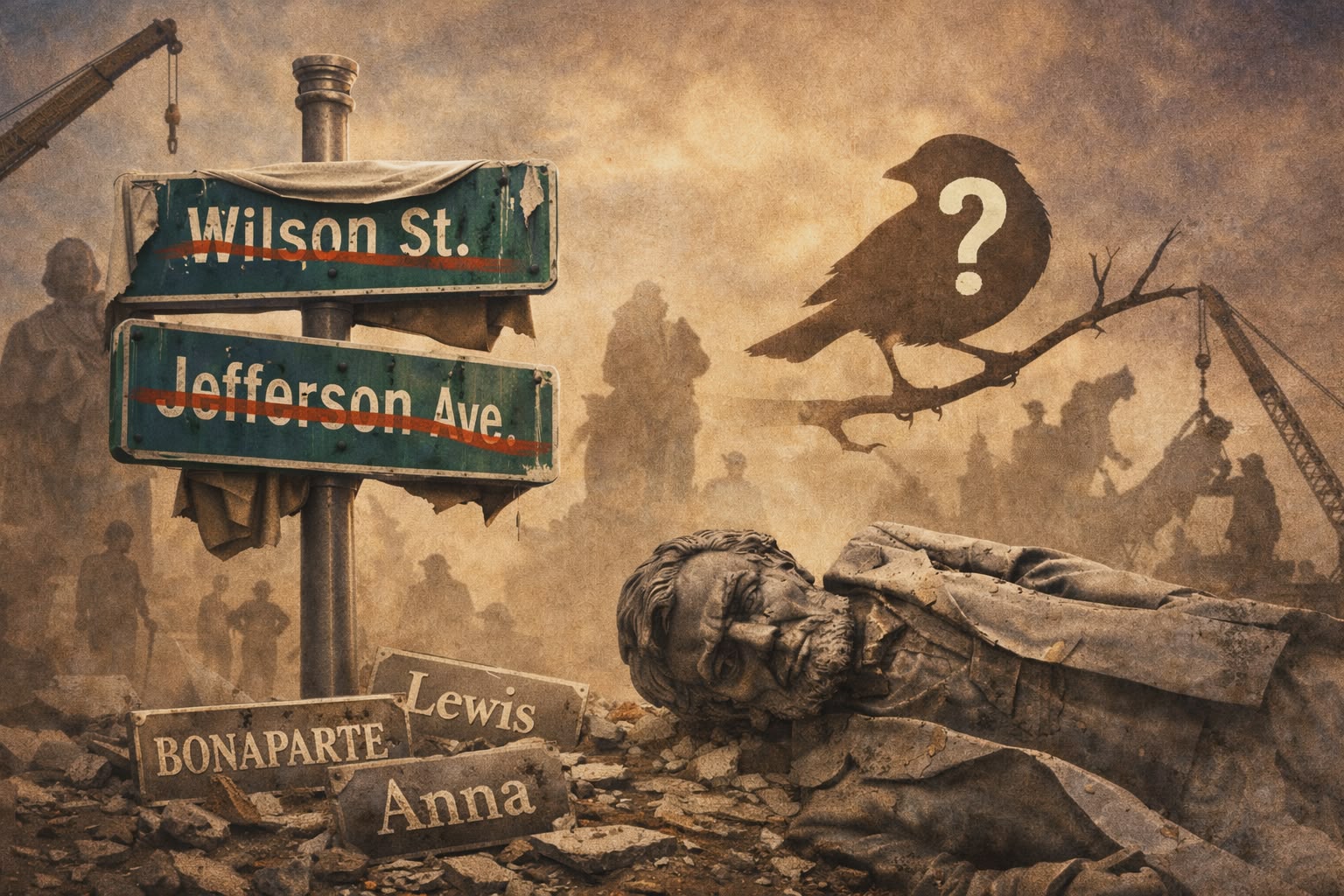
The trend of “disappearing” people’s names and images from public spaces brings up questions regarding ethics and whether we need history in our lives.
Another day, another name down the drain! The person had spent his lifetime trying to improve conditions for poor and overworked laborers. No doubt, his efforts brought attention to their plight. Unfortunately, there must have been a dark side to his life. He is said to have used his power and position to abuse other people. In just a few days his name quickly disappeared. No longer do we have a national holiday in his honor. His statues and street names were quickly covered or removed.
Another day, another group of names to be done away with. I have been a birder for most of my life. Watching birds helps me connect with nature. Recently a decision was made to eliminate people’s names from bird species’ common names. Wilson’s snipe, Townsend’s warbler, Bonaparte’s gull, Lewis’ woodpecker, Anna’s hummingbird—these are all examples. The argument made, by those demanding the name changes, is that in some cases the person (nearly all men) had slaves or had spoken or written in a positive manner regarding slavery.
Other points made in the effort to eliminate the people’s names is that they represented the imperialistic and capitalistic world that led to degradation and pain inflicted on minorities. Their argument states that the continued use of their names bestows honor to their terrible actions and philosophies.
I have to admit, even though I am a biologist with better-than-average acknowledge of history, I know very little about the offending Wilson, Townsend, Bonaparte, or Anna but know something of Lewis (of Lewis and Clark fame). During my years of birding, I never felt that I was supporting racism, slavery, unbridled capitalism or imperialism when I say, “look at that beautiful Clark’s nutcracker!” I just see a lovely bird that lives in our scenic high country.
Another day, more people to be done away with? Statues of Jefferson, McKinley, Washington, and Lincoln are toppled. Some say that they did reprehensible things in their day. Or, they expressed the patrimony that led to disease, death and wars. Take them down!
With all of these people or their names to be done away with, should we replace them with others? If so, by whom? In some cases, these statues represented heroes to our society or a portion of our society. So—do we pick new heroes? This brings up the risk of finding out, perhaps in future generations, that the replacement figures didn’t live up to the standards that we had wished, either.
One potential solution is to use minorities or women’s names for places or things. After all, they have never done anything wrong, did not believe in slaves, did not encourage capitalism or take over new lands, or treat their neighbors poorly—or did they?
Or, maybe a solution is not to name anything for anybody? We need to avoid the appearance of being hypocritical, so the first step would be to retroactively correct past errors. The city of Yreka can take the lead by starting with streets: Lane, Tebbe, Dillon, Hiram Page, Collier, Knapp, Lennox, Meamber, Dexter, Fairchild, and Blake have to go. Let’s be cautious about the alternatives–perhaps non-committal terms might be best: Up or Down Street; Hill or Valley Lanes might work. Directions, such as North, South, East and West Streets should be well-received, although some might feel that “North” pertains to Ollie North, so using cardinal directions might be risky.
On this voyage of correcting past mistakes, we can’t stop there. Let’s expand our geographic range: our County’s towns of Dunsmuir, McCloud, Weed, Hornbrook, Montague, MacDoel, Dorris, Ft. Jones, Callahan, Hilt, and Somes Bar all need to be rebranded. Perhaps we can do this by having renaming contests?
Then, let’s go after the California counties of Kern, Sutter, Lassen, Yolo, Amador and Solano. Perhaps we can use names of trees for replacements: Pine, Cedar, Willow, Cottonwood, or Locust might be safe county names.
If you do not like the wholesale slaughter of people’s names from our geography, perhaps you might advocate that we take an analytical approach. We could complete investigations of each person whose name is being used for a feature or item. We could compare everything they said or did with a list of criteria of what they should have said or done. (We could have public contests to determine the criteria to rate each person’s actions against.) If after the investigation a person passed muster with a 100%, their name can be used in public, if not—out they go!
I know, I am getting carried away, but I am trying to make a point. Is it morally correct to judge historical people with modern standards? If we are consistent in following that path we can get ourselves into some uncomfortable dilemmas. For instance, should we be critical of women 100-years ago that did not have careers, other than to take care of their friends and family? Should we now consider them as “lazy”? Or, should we “disappear” historical minority place names from our maps: Negro Creek, Indian Creek, Portuguese Creek, Kanaka Bar or the Owyhee (Hawaiian) River?
Instead of continuing with these name-changing gyrations, can’t we just agree that all people are flawed? I worry that eliminating names will erode our connection to history—both its good and bad sides. Don’t we need people to look up to, as well as others to shake our head at in shame? Don’t we all need history, traditions, heroes and antiheroes to help create lessons for our lives? By eliminating names we eliminate their stories and are left with a void in our culture and our souls. How can we have heroes if we are fearful that with enough scrutiny their shiny patina will turn to rust?





One Comment
Excellent, well written article.