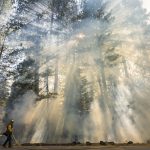

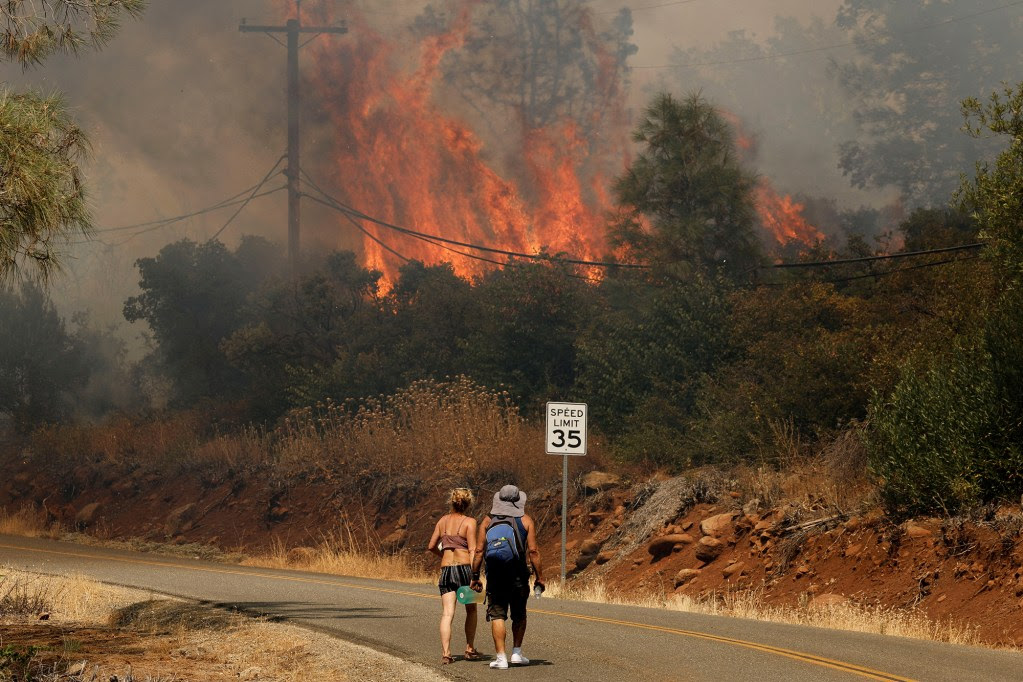
Ballooning to more than three times the surface area of Lake Tahoe, Park Fire is now the fifth largest fire in California’s history. Last week, investigators arrested a 42-year-old Chico man suspected of starting the blaze by pushing a burning car into a ravine.
But that’s not the most unusual way some of California’s destructive wildfires have started, writes CalMatters environmental reporter Julie Cart.
Whether they mean to or not, people are responsible for about 95% of the state’s wildfires. While arson accounts for about 10% of the fires, others can start in a myriad of ways. In 2022, the El Dorado Fire in San Bernardino and Riverside counties started after a smoke bomb went off at a gender-reveal party. The blaze killed one firefighter and cost $42 million to extinguish. And in 2018, a homeowner accidentally set off the Ranch Fire after hammering a metal stake into the ground.
Another cause of fires: Since 2015, power lines have caused some of the state’s most devastating wildfires, including 2018’s Camp Fire, which killed 85 people.
Find out the other ways California wildfires start in Julie’s story.
Speaking of the Park Fire: In addition to destroying homes and property, the 385,000-acre fire is also threatening Chinook salmon — one of California’s most iconic, and threatened, species.
As CalMatters water reporter Rachel Becker explains, the fire is burning in Tehama County, home to two of the three last remaining creeks where wild populations of the fish spawn.
If the fire spreads to higher altitudes, federal and state officials warn that it can kill off the rest of the region’s spring-run salmon. But the fire itself isn’t the primary threat. Later this year, rains can potentially wash toxic ash, sediment and fire retardant chemicals into the creeks, which can suffocate baby fish and eggs.
As one fisheries ecologist put it: “It’s like liquid cement coming down the river channel. It just scours the river down to the bedrock, and everything in it is crushed and ground up.”
Learn more about the fire’s threat to Chinook salmon in Rachel’s story.
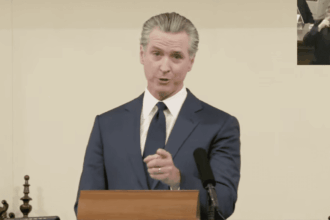
As for other fires: Julie also reports that Gov. Gavin Newsom traveled Tuesday to Kern County, where the fast-moving Borel Fire has consumed 57,000 acres and continues to exhibit “extreme fire behavior.”
Flanked by local and state fire officials, Newsom commended firefighters for increasing containment to 17%. But he offered a sobering fire outlook, which he characterized as “multiples of challenges.”
With wildfires sprouting up all over the state, Newsom cited the stats: 4,600 fires to date, consuming 750,000 acres. The five-year annual average is 4,400 fires burning up 140,000 acres.
The governor also praised the fire mutual aid system that deploys local, state and federal crews to fires around the West according to the most urgent need. California, which has already sent crews to Texas and Oregon this summer, is now asking for help — a call answered in part by Texas, which sent 100 firefighters to help fight the Park Fire.
California wildfires: To get a better sense of the Park Fire’s size, check out this interactive map by CalMatters data and interactives editor John Osborn D’Agostino and data reporter Jeremia Kimelman. And learn more about California wildfires in our updated explainer.
“reprinted with CalMatter.org blessing”
- CALFIRE SISKIYOU UNIT HAND CREW SELECTED FOR BLUE RIBBON AWARD
- 10th DAA selects Kenny Elwood for 2026 Golden Pass
- FICTITIOUS BUSINESS NAME STATEMENT: Carson’s Window Coverings & More
- Traffic Stop in Siskiyou County Leads to $1.9 Million Cocaine Seizure, Driver Arrested
- F-35A Lightning II Jets from Luke AFB Arrive for Two-Week Training at Kingsley Field