
By Anat Rubin, CalMatters
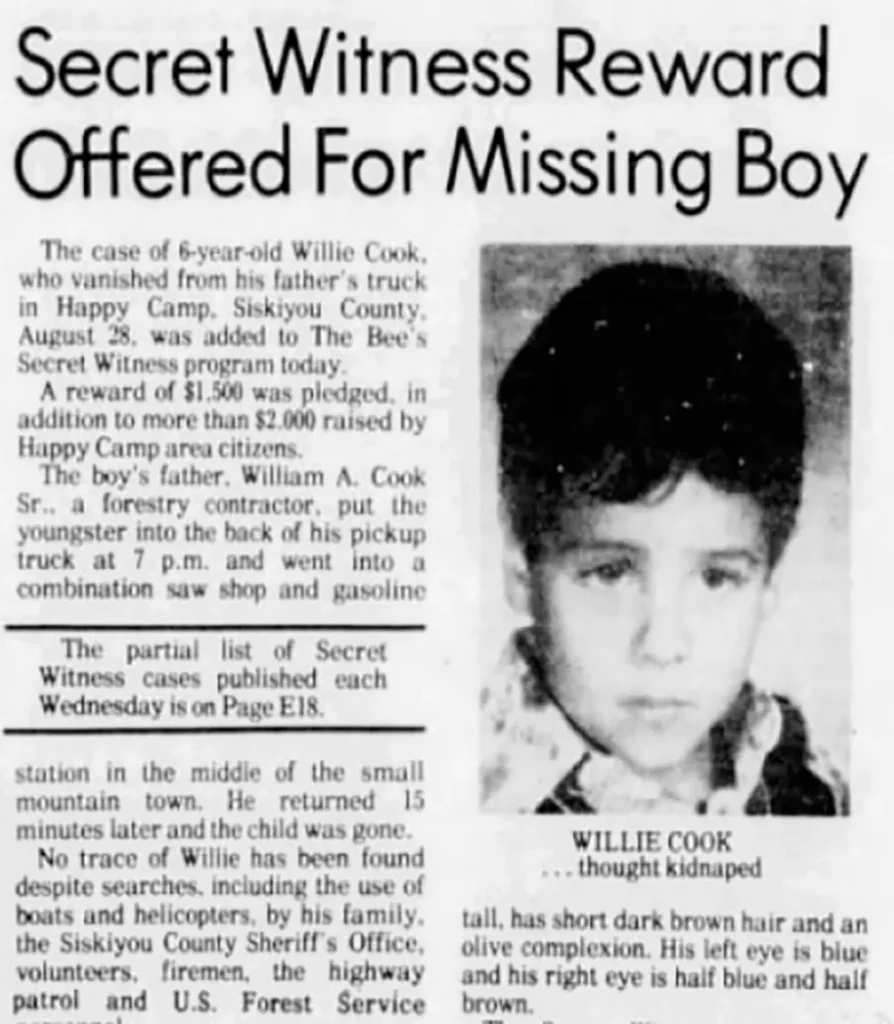
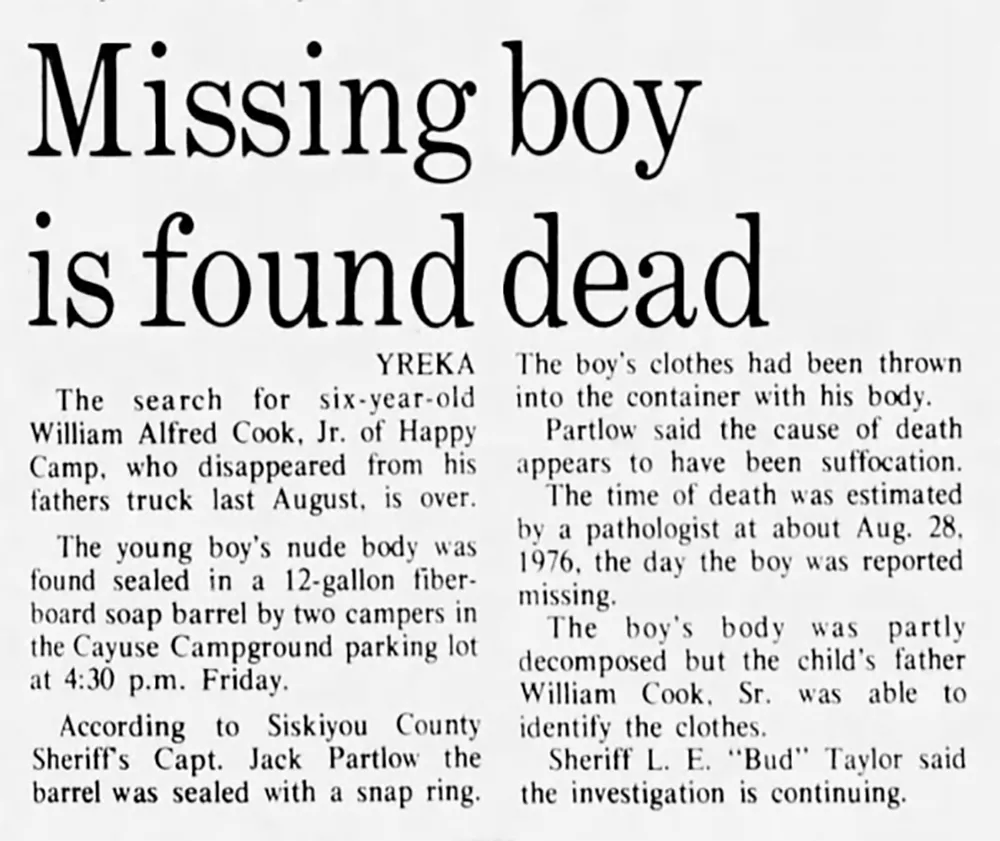
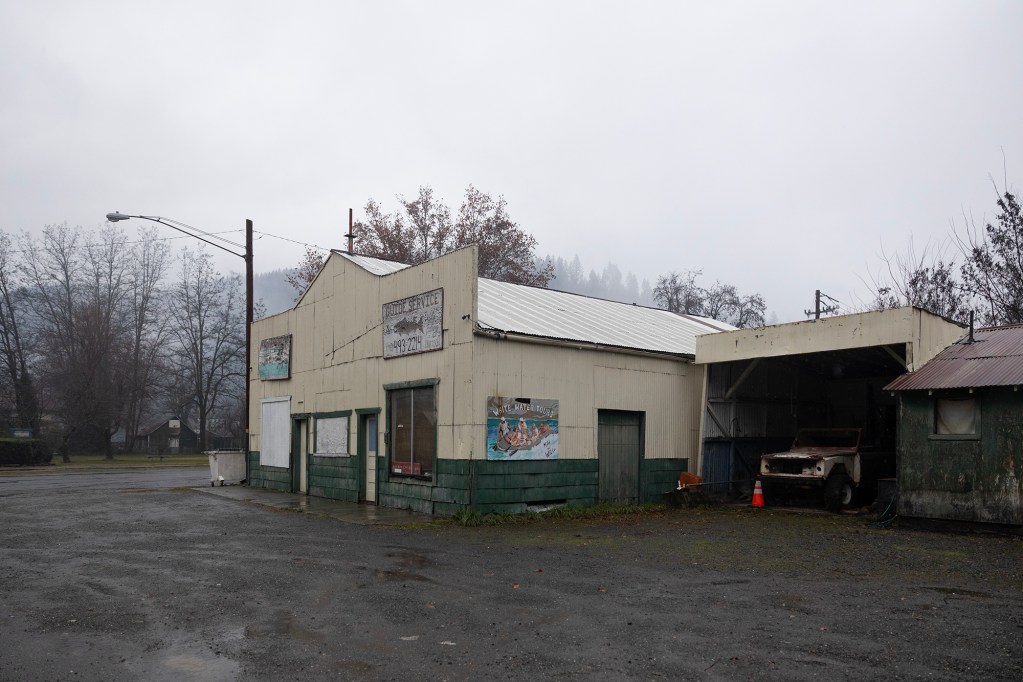
On Aug. 28, 1976, sometime between 7:30 and 8 p.m., a 6-year-old boy named Willie Cook disappeared from the bed of his father’s pickup in Happy Camp, a secluded logging community in Northern California’s Klamath National Forest. Willie’s father, Bill Cook, had been working on his lawn mower at a repair shop in the center of town. When he was done, he told Willie to wait in the truck with the family dog while he ducked into the bar across the street. He was gone less than 20 minutes. The sun had set behind the mountains, but there was still light in the sky.
Cook searched the area on foot, then drove in the direction of the family home. After he circled town a couple more times, he called law enforcement to report that his son was missing. He gave the local deputy a description: Willie was 42 inches tall and weighed 45 pounds. He was wearing a black baseball jersey, jeans and white tennis shoes. His right eye was blue, and his left eye was a mix of blue and brown. He was, Cook said, “a very good boy, and had never wandered off in the past.”
By midnight, 150 people were searching for Willie, combing the dense woods surrounding the town. But Cook did not believe his son was lost in the forest. From the moment he had walked out of that bar, he was certain that someone had taken him. “I felt it,” he said. “I felt it all over.”
Willie’s body was discovered six months later in a small cardboard barrel at a campground along the Klamath River, more than 50 miles from Happy Camp. The Siskiyou County sheriff’s office launched a murder investigation but never solved the case.
After 32 years, sheriff’s deputies got their first big break when a man came forward to say he had witnessed the kidnapping. Steve Marshall was only 10 years old in 1976, but his memory of that August day was vivid: He was sitting alone in his mother’s blue station wagon, parked outside the Headway Market, within view of the repair shop and the old bar. He was eating a vanilla ice cream cone. His brother was inside the market with their mother. They would be having spaghetti for dinner that night — his favorite.
Marshall seemed to remember what happened next as though it were unfolding in slow motion: The sound of a logging truck as it roared past. Willie’s Labrador wagging his tail. And a young man in blue jeans and a vest, his long hair in two braids, standing on the opposite side of the street, staring at the boy and his dog.
Marshall recognized him. His name was Gregory Nelson. And Marshall said he had a clear view of him as he crossed the street, grabbed Willie, shoved him into a VW bus and drove off, disappearing down the one-lane highway that cut through town. Marshall had tried to tell his mother what he’d seen, but she’d brushed him off. For the next few decades, he mostly kept it to himself. But the memory, he said, had haunted him.
The Siskiyou sheriff arrested Nelson, then 51, and brought him in for questioning. He had a couple grams of methamphetamine and several syringes in his pocket. After two days of interrogation, he confessed. The following day, the sheriff told a local reporter that a cold case is like a puzzle. “After 32 years, we’re finally getting the pieces put together.”
Nelson was charged with kidnapping and murder. Siskiyou’s chief public defender, Lael Kayfetz, thought there was little chance of overcoming a signed confession and an eyewitness account. Then the prosecutors turned over the recordings of Nelson’s interrogation. When Kayfetz watched the footage, she said, “my eyeballs fell out of my head.”
She realized she needed to test the claims against her client, but she couldn’t do it on her own. “I’m an expert on the law,” Kayfetz said. “I’m not an expert on getting the facts.” She needed an investigator.
The prosecutors were working closely with detectives at the sheriff’s office, issuing warrants and building a case. They also employed their own team of five investigators.
That year, Siskiyou County’s public defender didn’t have a single defense investigator on staff.
***
Lawyers have a constitutional obligation to investigate every case. But a CalMatters investigation found that poor people accused of crimes, who account for at least 80% of criminal defendants, are routinely convicted in California without anyone investigating the charges against them. Close to half of California’s 58 counties do not employ any full-time public defense investigators. Among the remaining counties, defendants’ access to investigators fluctuates wildly, but it’s almost always inadequate.
The cost of this failure is steep, for individual defendants and for the integrity of California’s criminal justice system. Of the 10 California counties with the highest prison incarceration rates, eight have no defense investigators on staff, according to an analysis of staffing and prison data.
The lack of investigators affects counties throughout the state, from poor, rural areas like Siskiyou to the state’s largest and most well-funded public defense offices. Los Angeles employed just 1 investigator for every 10 public defenders — one of the state’s worst ratios, according to the most recent data from the California Department of Justice. Only seven California counties met the widely accepted minimum standard of 1 investigator for every 3 attorneys.
The situation is most alarming in the 25 California counties that don’t have dedicated public defender offices and pay private attorneys to represent indigent people in criminal court. Most of these attorneys receive a flat fee for their services, and the cost of an investigator would eat away at their profits. Some counties allow contracted attorneys to ask the court for additional funds for investigations, but court records show the attorneys rarely make those requests.
In Kings County, which has one of the highest prison incarceration rates in California, contracted attorneys asked the court for permission to hire an investigator in 7% of criminal cases from 2018 to 2022. In Lake County, attorneys made those requests in just 2% of criminal cases over a three-year period; in Mono County, it was less than 1%. To earn a living from meager county contracts, research shows, private attorneys and firms must persuade defendants to accept plea deals as quickly as possible. An investigation is an expensive delay.
Defense investigators interview witnesses, visit crime scenes, review police reports and retrieve video surveillance footage that might prove the defendant was on the other side of town when a crime was committed, or that an assault was an act of self-defense. They do work that most lawyers are not trained to do. Without them, police and prosecutorial misconduct — among the most common causes of wrongful convictions — remain unchecked, significantly increasing the likelihood that people will go to prison for crimes they did not commit.
“Law is important, but the facts are what influences the law,” said Aditi Goel, executive director of the Sixth Amendment Center, a national nonprofit focused on improving indigent defense. “The heart of a case is what happened.”
***
In 2008, Kayfetz and her four staff attorneys were left to sleuth most cases on their own, and they worried about what they might be missing. Siskiyou County provided them with a small budget to contract with a private investigator, but the Nelson case, which had already spanned three decades, would burn through their entire investigation fund for the year. Still, Kayfetz didn’t feel as though she had a choice. Nelson was facing life in prison, and the sheriff was in the papers talking about closure for the Cook family.
She called Rob Shelton, an investigator who had spent most of the previous two decades in law enforcement — first with the Coast Guard, then as a harbor patrol officer in Ventura, and recently as a probation officer for Siskiyou. He’d crossed over into defense investigations, and this would be his first homicide case for the public defender’s office.
Nelson’s mug shot had by then been published on the front page of the Siskiyou Daily News. His hair was graying, and his cheeks were deeply sunken. Shelton knew that look. He had seen it on the probationers he had monitored, people whose hard lives were etched into their faces. He had come to view their struggles with the law as a symptom of their poverty and addiction. But he also believed Nelson was guilty. It was hard for him to imagine that the sheriff would pursue a case without concrete evidence, and even harder to believe that the district attorney would push it toward trial.
Kayfetz handed Shelton the records she’d gotten from the prosecutors, and he spent those first few weeks combing through old police reports.
As he made his way through the documents, he found black-and-white copies of photographs the sheriff’s deputies had taken as they searched Happy Camp in the days after Willie’s disappearance: The chain-saw repair shop where the truck had been parked. The old bar across the street. And a building that looked as though it had recently burned down. It was familiar to Shelton, though he couldn’t initially place it.
Then one day, while he was staring at the photo, it clicked. It was the Headway Market, where Marshall said his mother had been shopping when he witnessed the kidnapping.
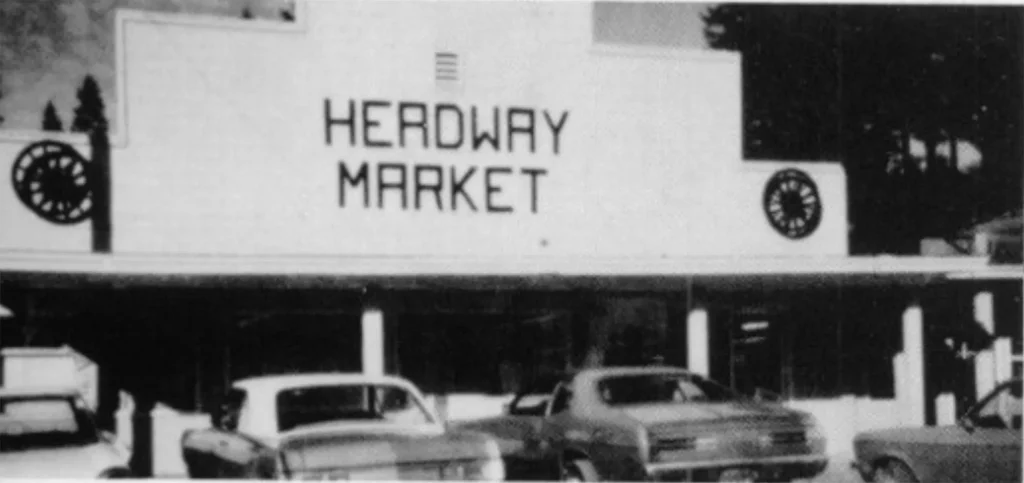
“There was no store,” Shelton said. “There was just ruins.”
Shelton walked down the street to the Siskiyou County assessor’s office to pull records on the property. The market, he learned, had burned down a few months before Willie Cook was taken.
***
California is the birthplace of public defense. The nation’s first public defender office opened in Los Angeles in 1913. By the time the U.S. Supreme Court established in 1963 that defendants have the right to an attorney in state criminal proceedings, more than a dozen California counties were already providing free representation to poor people accused of crimes. As the nation caught up, California slipped behind. The state kept its defender system entirely in the hands of its counties. Today, it is one of just two states — alongside Arizona — that don’t contribute any funding to trial-level public defense, according to the Sixth Amendment Center. The state does not monitor or evaluate the counties’ systems. There are no minimum standards, and for many defendants there are no investigations — even in the most serious cases. Meanwhile, prosecutors have robust, in-house investigative teams. In Riverside, the district attorney has 30% more lawyers than the public defender but 500% more investigators, state data shows, in addition to the support of the county sheriff and various municipal police departments. This pattern repeats throughout the state. In what is supposed to be an adversarial legal system, indigent defendants and their attorneys are often on their own, facing an army of investigators who are working to secure a conviction. Hidden in that data is the greatest tragedy of failing to investigate cases: wrongful convictions. The National Registry of Exonerations is filled with cases in which convictions were overturned when someone finally looked into the prisoner’s claims, years or even decades after they were imprisoned. Hundreds of those cases are in California. In one exoneration out of Fresno, Northern California Innocence Project investigators found nine witnesses who corroborated their client’s alibi: He was more than 25 miles away at a birthday party at the time of the crime. In a recent case out of Los Angeles, investigators found evidence of their client’s innocence in a police detective’s handwritten notes, material that had been included in a file turned over to the defense before trial. If their cases had been investigated on the front end, these men might have been spared a combined 30 years in prison. Maurice Possley, the exoneration registry’s senior researcher, said that a failure to investigate is at the heart of most of the registry’s 3,600 cases. When he looks at the evidence that overturned these convictions, he’s astounded the defense didn’t find it when the case was being prosecuted. “If someone had just made the effort,” he said. “This was all sitting there.” ***
Shelton was in his early 40s when he got the Nelson case. He had been living in Siskiyou for years, but he hadn’t shed his Southern California accent. He was soft-spoken, smiled often, and had the easy mannerisms of someone who had spent a lot of time at the beach. It didn’t take long for him to build a rapport with Nelson, and he visited him frequently at the Siskiyou County jail. Nelson told him he had no memory of the events that Marshall had recounted for the deputies. Those claims of innocence had sounded hollow to Shelton, but the picture of the burned market changed his thinking about the case. Now he wondered whether anything Marshall had said was true.
Detectives with the Siskiyou sheriff’s office had interviewed Marshall several times in October 2008, a month before they arrested Nelson. Kayfetz requested those recordings, and she and Shelton listened to the tapes.
In the first interview, Marshall initially hedged his words. When a detective asked him whether he saw Willie — who was Marshall’s cousin — on the day he was taken, he said that it “seemed like” he did. Then he said that he watched Nelson grab Willie and put him in the van, where another man was crouching in the passenger seat.
“You saw that?” the detective asked.
“That was with my own eyes I saw that,” Marshall said.
Minutes later, in a second accounting, Marshall added an accomplice — the woman who would later become Nelson’s wife slid the van door open and jumped inside before they drove off. Three days later, an additional woman appeared in the story — the wife’s sister — and the man in the passenger seat was gone.
It was remarkable to Shelton that the detectives didn’t challenge Marshall on these discrepancies. Each time he told the story, he added details — the ice cream flavor, the face his brother made at him as he walked into the market.
When a detective asked whether Marshall had said anything to his mother when she came back, he replied that he had tried but that his brother was teasing him. “That’s why I just threw it aside,” he said. “Because my brother, he made me mad.” Marshall eventually told his mother what had happened, he said, but neither of them mentioned it to Cook when they joined the search party later that night.
In a separate interview with detectives, Marshall’s mother corroborated his account. “I should have listened to him,” she said. “It was like he was trying to tell all of us that he had seen who took Willie. Is that possible? But nobody would believe him, because he was a little boy.”
In one of the recordings, the detectives alluded to some kind of legal trouble Marshall was facing. “You’re taking care of us, and we’re going to scratch your back in return,” a detective had promised him.
During his fourth and final recorded interview with detectives, Marshall had something new to share: He wasn’t just a witness to Willie’s kidnapping. He was also a witness to his murder. Months after the kidnapping, Marshall said, he took a trip with his father to visit his grandparents on the Hoopa reservation, some 70 miles from Happy Camp. It was there, he said, while hiding behind a tree in the back of Nelson’s house, that he saw Nelson take Willie out of a locked van and heard him say, “This is the last time you’re going to even breathe air.”
“I’m standing right there, and I’m watching him from that tree,” he told a detective. “I’m watching him put his hands around that little boy and strangle him until that little boy was dead.”
The detective conducting the interview initially seemed alarmed by this change in the story. She told Marshall that her sergeant would need to speak with him “about the differences in your statement from the first time that we talked to you.” She left the room but came back alone. “I think you and I pretty much clarified everything,” she said.
In her report, she wrote that Marshall had witnessed the murder “four or five days” after the kidnapping. That was an error — Marshall repeatedly said four or five months had passed between the kidnapping and the murder, according to a transcript of the interview. But that error would find its way into Nelson’s confession.
From Marshall’s testimony, police and prosecutors created their theory of the crime, interview transcripts and court filings show. They proposed Nelson was a pawn in a scheme hatched by his sister-in-law — one of the women Marshall named as an accomplice — who wanted to hurt Cook by taking his son. Maybe she had been jealous of his success. Maybe she wanted to avenge her husband, who had been tried, and later acquitted, for the murder of Cook’s brother.
Nelson and his sister-in-law were both Native American. To Kayfetz, law enforcement’s assumption that they would kidnap and kill a child as an act of revenge, or in a fit of jealous rage, played into racial stereotypes and became the “underlying stench” of the case.
The evidence had suggested that Willie was kidnapped by a sexual predator. His body was naked when it was discovered. Now law enforcement posited he was murdered in a family feud.
Even Willie’s father initially had a hard time believing this theory. “I just can’t imagine that,” Cook told a detective in 2008. “Over something that stupid? My gut feeling is no.”
But the deputies were insistent. Eventually, Cook began to come around to the possibility that Nelson was the killer.
Deputies exhumed Willie’s body, but it did not provide any new evidence. Far too much time had passed.
***
When Shelton began working on the case, he was shocked whenever he discovered that law enforcement had made a mistake, or that prosecutors had failed to turn over a key document.
He would burst into Kayfetz’s office, saying, “You’re not gonna believe this!” And Kayfetz would tell him, dryly, “There’s no Santa or Easter Bunny, either.”
He would soon lose that sense of disbelief.
As the investigation progressed, Shelton became convinced that Marshall had invented most of his story. Marshall had given detectives the names of other potential witnesses, but those turned out to be dead ends. Still, Siskiyou’s district attorney, Kirk Andrus, seemed determined to move forward, and Nelson was losing hope.
Then, one day, while he was looking through old police files, Shelton found a list of materials the deputies had entered into evidence in 1976. It included references to interviews they recorded with potential witnesses. Shelton scanned the list and saw Marshall’s name. The prosecution’s star witness had spoken to officers just days after Willie disappeared. If law enforcement still had access to these recordings, they hadn’t shared them with the defense.
When Kayfetz asked the district attorney’s office to turn over the evidence, the prosecutors said they didn’t have it. But Shelton learned the tapes from the case had recently been digitized and enhanced by the Justice Department, at the request of the Siskiyou detectives. Kayfetz filed a second motion to get the recordings. When the judge ordered the prosecutors to explain how the tapes had gone missing, they said that they had found them and that they had been lost on a detective’s desk, according to court documents.
Soon Kayfetz and Shelton were listening to Marshall, 10 years old, answering questions about the evening Willie disappeared. There was no ice cream. Marshall’s brother was not in the car, but his older sister was. Their mom didn’t go to the grocery store, but she did stop at a liquor store to buy a TV Guide. When they drove through the center of town, Marshall waved to Willie, who was sitting in his dad’s truck.
“I said, ‘Hi, Willie,’ and he said ‘Hi’ back. And I said, ‘Where’s your dad?’ And he said, ‘He’s in the bar.’” When they drove by again, Willie was gone.
“Am I allowed to go now?” Marshall asked the detective.
In a separate interview that same day, Marshall’s mother corroborated her son’s account. Nobody mentioned Nelson. Nobody said anything about witnessing a kidnapping.
***
Shelton felt as though they were pulling a string and unraveling the district attorney’s case.
He discovered that Marshall had a motive for becoming useful to law enforcement in the fall of 2008. He had violated the terms of his probation for a drunken-driving conviction and was facing prison, but police kept the violation off his record, Shelton said.
Kayfetz was encouraged by the evidence that was mounting in Nelson’s favor, but if the case went to trial, she would have to contend with the fact that he had confessed to the crime.
She sent the footage of his interrogation to Richard Leo, a University of San Francisco law professor and one of the nation’s foremost experts on coerced confessions, and asked him to testify on Nelson’s behalf. She couldn’t afford his fee — she was already pushing the outer limits of her budget. And when she first reached out, Leo told her he didn’t have time to take on another case. But she begged him to watch the footage before he made up his mind.
Even now, almost 17 years later, he remembers how stunned he had been when he first saw it. Among the 2,400 cases he’s consulted on, he said, the Nelson case stands out as one of the most egregious examples of a coerced confession he has ever seen. He called it “a form of psychological torture.”
“There’s a sequence to this — a long interrogation, lie to the suspect about evidence, attack the suspect’s denials, cause him to doubt his memory,” he said. “Sometimes you see this person denying and admitting at the same time: ‘I couldn’t have done this. I have no memory. You’re telling me I did this, maybe I did this.’”
Leo said Nelson was subjected to almost every tactic known to lead to a false admission of guilt. He agreed to do the case for a reduced fee — a “bro deal,” Kayfetz called it — in exchange for permission to include it in a future book.
More than 12% of the wrongful convictions listed on the National Registry of Exonerations involved false confessions. In a recent case in San Bernardino, police officers pushed a man to admit to killing his father after he called police to report him missing. During a marathon interrogation, officers told the man they had conclusive evidence of his guilt and got him to agree with a gruesome scenario that they had pulled, it seems, from thin air. A few hours after he confessed, police officers located the man’s father. He was alive and well.
***
In 2007, the Bureau of Justice Statistics conducted a census of the nation’s public defender offices. It found that 40% had no investigators on staff and that 93% failed to meet the National Association for Public Defense’s industry standard of at least 1 investigator for every 3 attorneys. The study made it clear that, across the country, investigators were seen as a luxury, not a necessity. CalMatters interviews with top public defenders in several states, along with recent reports examining indigent defense systems, suggest that’s still the case. In Mississippi, only eight of the state’s 82 counties have public defender offices. The rest rely on private attorneys who are paid a flat fee — one that rarely covers the cost of an investigator. A 2018 report found that, in many Mississippi counties, with the exception of murder cases, the attorneys “never hire investigators and have no time to investigate cases themselves.” Appointed attorneys told researchers they would “get laughed out of court” for requesting additional funds for an investigator. Public defender systems that are funded and controlled by state legislatures also have severe investigator shortages. The head public defender in Arkansas, Gregg Parrish, said he has only 12 staff investigators, responsible for assisting in felony cases, including capital cases, in all of the state’s 75 counties. Minnesota’s top public defender, William Ward, said he is trying to maintain a ratio of at least 1 investigator for every 7 public defenders but knows that’s not enough. “I would rather have a great investigator and an average lawyer than an average investigator and a great lawyer,” he said. “Investigators make all the difference on a case.” Colin Reingold remembers one case in particular from his time as a public defender in Louisiana’s Orleans Parish. His client was accused of breaking into a car, but he insisted he was entering the car to leave a note offering to do yard work. Reingold sent an investigator to the car owner’s house, but there was no one home. His client had two prior felonies, and a car burglary would qualify him for a life sentence. When the prosecutor offered 10 years in exchange for a guilty plea, Reingold advised him to take the deal. But his client begged him to find the note, he said. That year, Orleans Parish had 65 public defenders and three investigators. The one assigned to the man’s case refused to give up. She tried for six weeks to find the car’s owner. In the week before the plea hearing, she stopped by his home almost daily. One evening, he answered the door. He said, “Oh yeah, I still have that note!” Reingold presented the note as evidence, and his client was released from jail. It was, he said, a rare stroke of luck. “The scary thing is, we don’t know all the other times we’ve missed things like that.” ***
Just weeks before Nelson’s trial was set to begin, the prosecution was still turning over discovery materials.
Shelton began to make his way through the latest batch. Many of the documents were familiar — duplicates of reports and transcripts he had already reviewed. But he stumbled on a few photographs, tucked into the file, that he hadn’t seen before. In the foreground of one of the pictures, leaning up against a trailer home, something caught his eye — a cardboard cylinder, not quite 2 feet tall. It looked just like the barrel in which Willie’s body was found.
“Jesus Christ, man. That’s it right there,” he said to himself. “It was in their hands. They had it all along.”
The trailer belonged to a man who had lived in Happy Camp in the 1970s and whom everyone knew as Sonny. He washed trucks for a local logging company and lived on the owner’s property. Cook told police he had been on that property with Willie the day of the kidnapping, which is probably why the deputies photographed the area.
When Shelton went back to Happy Camp to learn more about Sonny, he discovered he had been arrested less than a year after Willie’s body was found, when a 5-year-old boy told his parents that Sonny had sexually abused him. The boy’s family had owned the logging company, and Sonny had been their employee. Prosecutors didn’t file charges, and Sonny was released.
According to documents Kayfetz filed with the court, the boy, who was in his late 30s when Nelson was arrested, had always wondered about the connection between Willie’s murder and his own abuse. His grandmother once told him she believed the cardboard barrel had come from their family’s property — she said it was a container for the detergent that Sonny used to wash the trucks.
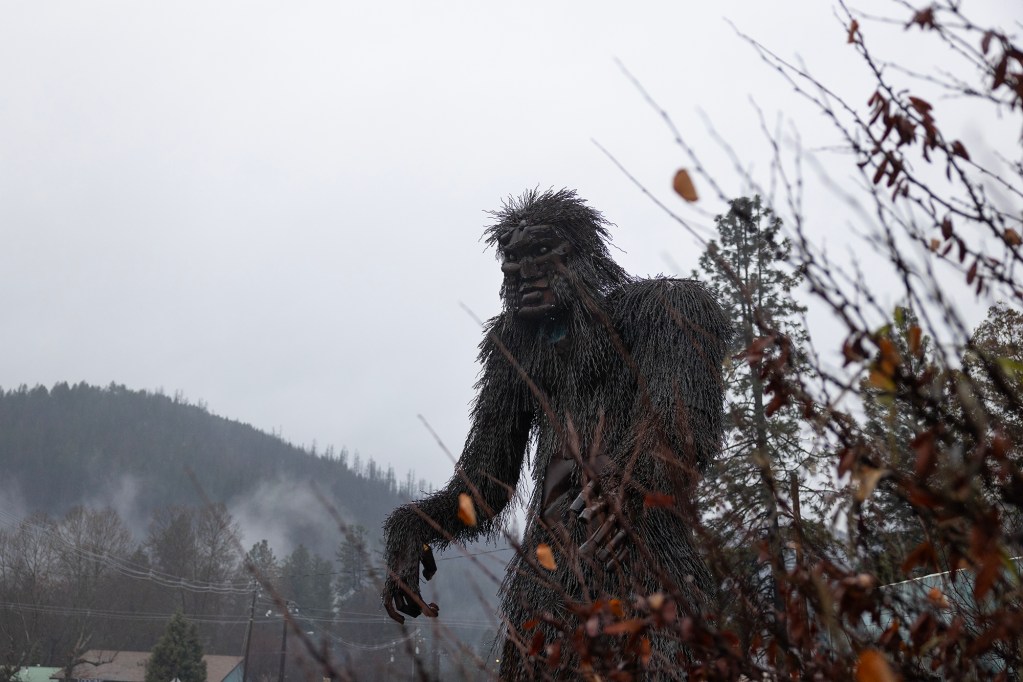
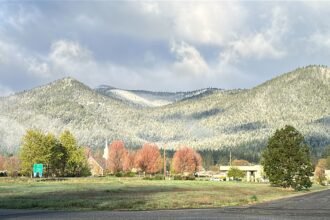
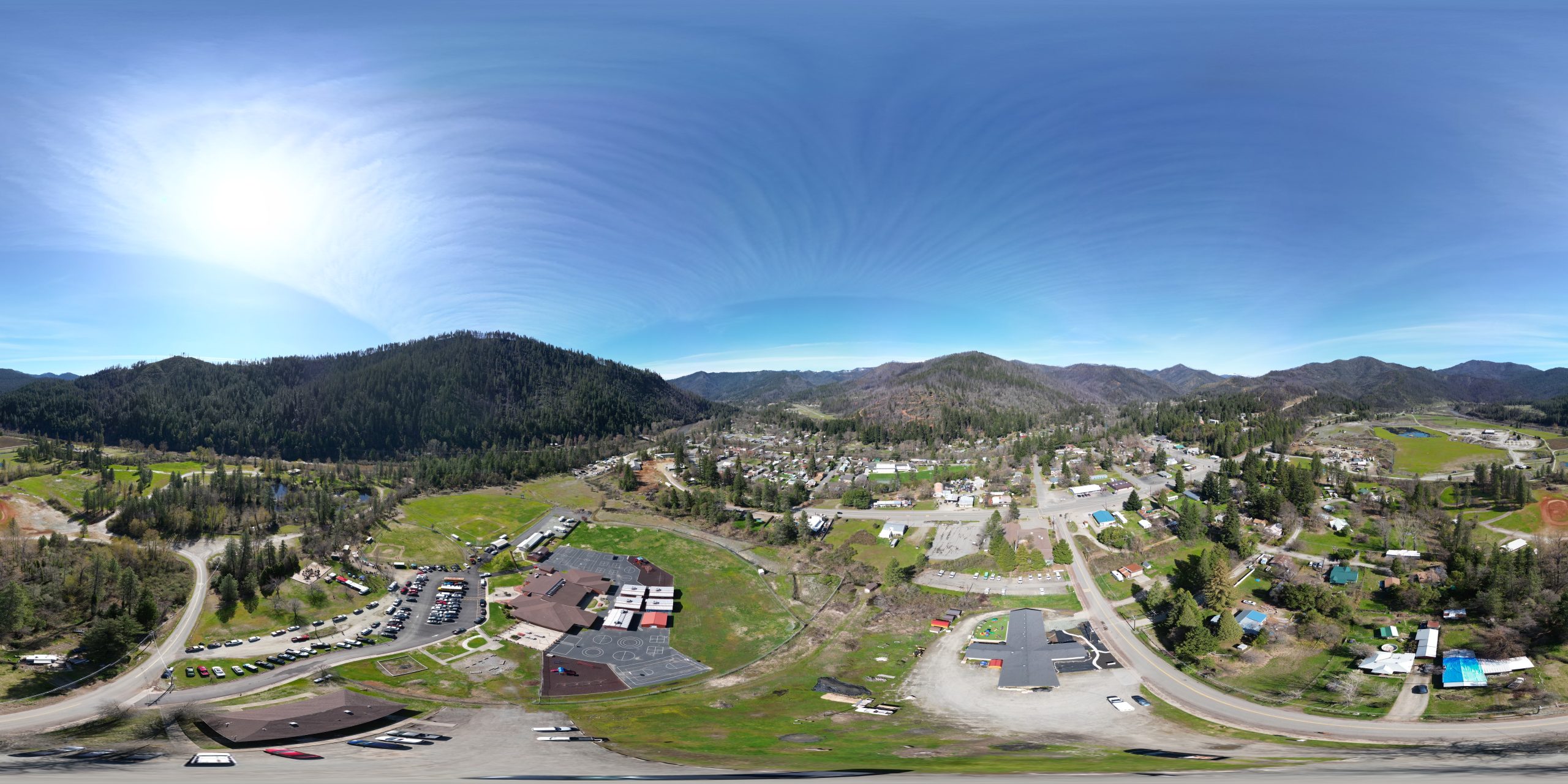
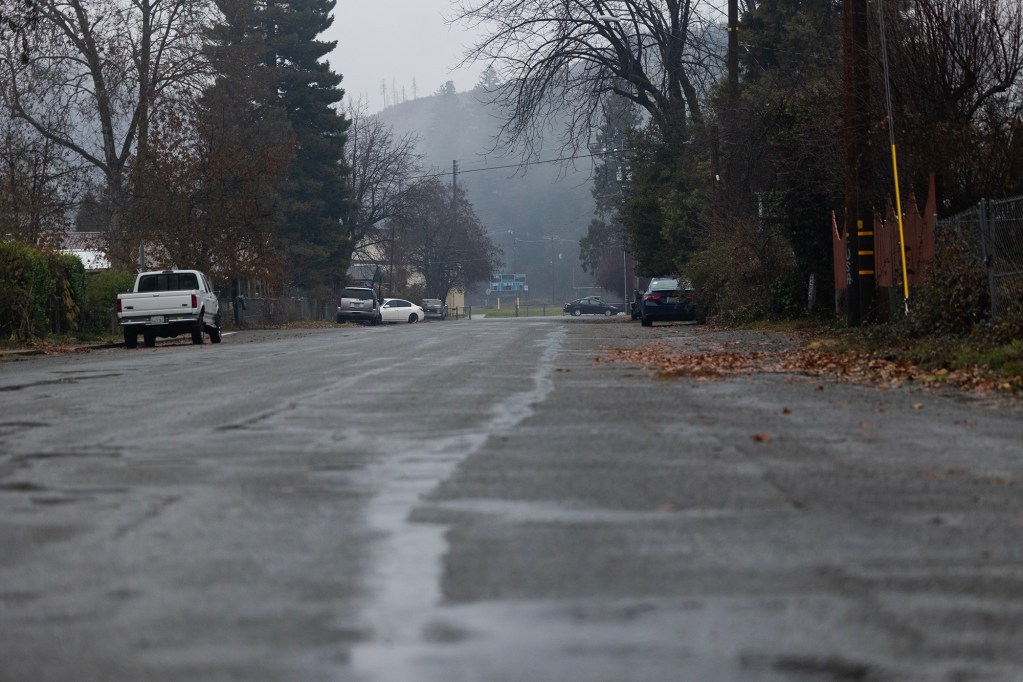
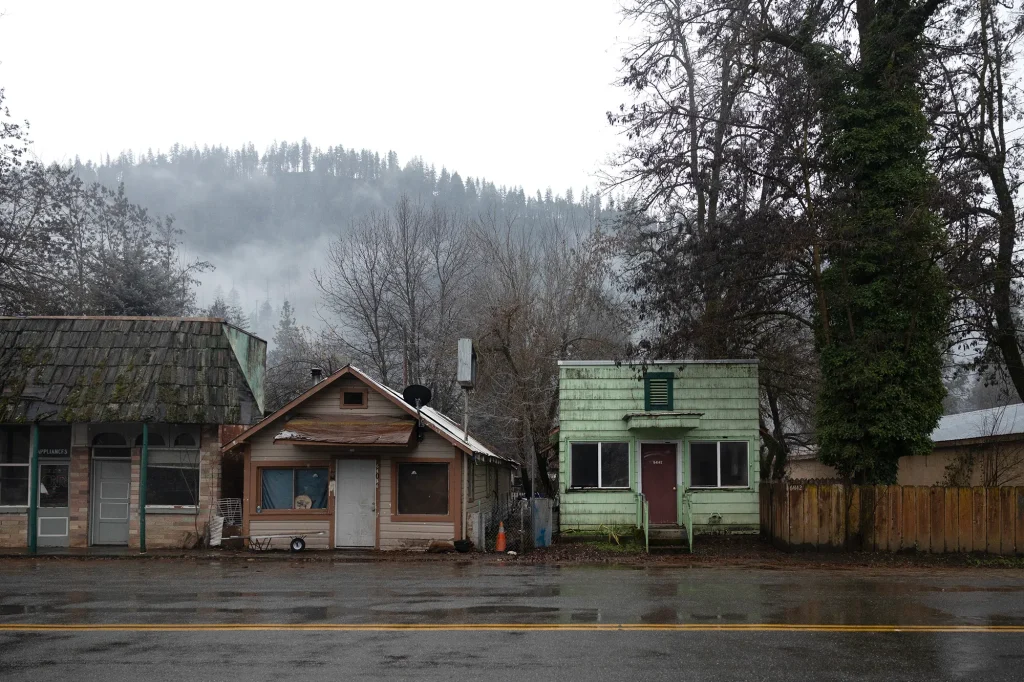
First: A view down Washington Street in Happy Camp on Dec. 13, 2024. Last: Buildings on 2nd Avenue in Happy Camp on Dec. 13, 2024. Photos by Miguel Gutierrez Jr., CalMatters
He had recently searched for the Cook case online and was surprised to find that it had been reopened and that Nelson had been charged with the crime. He wondered: Did the police know about Sonny?
The local press had published a phone number for the Siskiyou detective’s bureau, urging people to come forward with relevant information about the crime. He called and left a message, but no one called him back. He called a second time and explained to a receptionist who he was and why he was calling. He was still waiting for a reply.
Sonny did eventually go to prison for sexually abusing a child. A mother reported him to the police when she learned he had been molesting her son for years. She told investigators that after Sonny was sentenced, other boys came forward to say he had abused them as well, according to a statement filed in court. He died in 2001.
To Shelton, these discoveries seemed like “a game changer.” He shared the details with Kayfetz. “I was like, ‘This is done,’” he said.
But the jury would not get to see the photo of the barrel or hear from Sonny’s accusers. The prosecution fought to exclude the evidence, arguing it didn’t prove Sonny had ever met Willie, let alone had kidnapped and killed him. And the judge agreed.
“It never even made it to court,” Shelton said. “Our job was to create reasonable doubt. We never planned to solve this case and figure out who did kidnap Willie. But I think we did, and no one cared.”
The case would radically alter Shelton’s beliefs about the justice system and his perception of how police and prosecutors operate. “I used to be on their team,” he said. “And when I worked for the defense I started to see that, you know, sometimes it’s more about winning than actual justice.”
He began to view his job as “quality control” for law enforcement agencies.
“Some district attorneys are wonderful and they disclose everything,” he said. “They’re not all like that. And so, if you’re a defendant and you draw a dishonest attorney, well, is that it? Is your fate sealed?”
It would be, Shelton said, if you didn’t have anyone to look into your side of the story.
***
Over the past 20 years, California has introduced ambitious legislation aimed at reducing incarceration, earning the state a reputation as a leader in criminal justice reform. But those efforts are routinely undermined by California’s failure to provide defendants with a proper investigation of the charges against them.
“That’s what’s so shocking — that it’s California,” said Goel, of the Sixth Amendment Center. “There’s perception, and then there’s reality. When will the state look in the mirror and see what it really is?”
Investigations affect every part of the criminal justice process. They’re not just about figuring out whether a client is innocent. Even if a case is moving toward a plea deal, an investigation can turn up information that forces a prosecutor to reduce the charge or compels a judge to grant bond or shorten a prison sentence.
Lawyers are discouraged from interviewing witnesses on their own. If a witness later changed their story or disappeared before trial, the attorney might have to testify on their client’s behalf and recuse themself from the case.
California lawmakers are considering a bill that could bolster defense investigations by eliminating flat-fee contracts. But it faces opposition from county officials, who say it would force them to increase their defense budgets without helping them pay for it.
New York was once very similar to California. Its counties managed their own public defender systems, without much input or funding from the state, until a class-action lawsuit, settled in 2015, led to statewide changes.
New York created an office tasked with improving public defense, eventually giving it some $250 million to dole out each year. Counties that take the money must prioritize certain aspects of public defense, including investigations. In a recent report to the agency overseeing the effort, these counties consistently said the ability to investigate cases was among the most profound impacts of the new funding. Some described specific cases that ended in acquittal or significantly reduced charges as a result.
California was also sued over claims it failed to provide competent defense. To settle the lawsuit, filed in Fresno County, Gov. Gavin Newsom in 2020 expanded the scope of the Office of the State Public Defender, which had previously handled death penalty appeals, to include support and training for county-based public defender systems.
But the governor committed only $10 million in one-time grants to the effort, and that money has since run out.
***
Nelson’s trial began in September 2009. The case hinged on Marshall’s account and Nelson’s confession. Kayfetz built much of the defense on what Shelton had discovered.
The jury deliberated for six days and could not come to a decision. Seven jurors believed Nelson was guilty of murder, and five did not. Six believed he had kidnapped Willie, the other six did not. The judge declared a mistrial. A few weeks later, Andrus, the district attorney, announced he was dismissing the charges against Nelson and his sister-in-law, whose kidnapping case was awaiting trial.
In a press release, Andrus said it was “the most difficult and painful decision I have made in my professional career.” He told a news reporter that his office had a heavy caseload and didn’t have the staff to prosecute the case. Andrus noted that he could always refile the charges if new evidence emerged or a new witness came forward.
Nelson was released, but he didn’t get to go home. He had to answer for the drugs he had on him at the time of his arrest and was sent to a Humboldt County jail.
“I left here just to be interviewed, and 16 months later I got out,” Nelson said from his home in Hoopa. “They got their hook in me, and they kept it in me. There’s nothing you can do when you’re in that situation.”
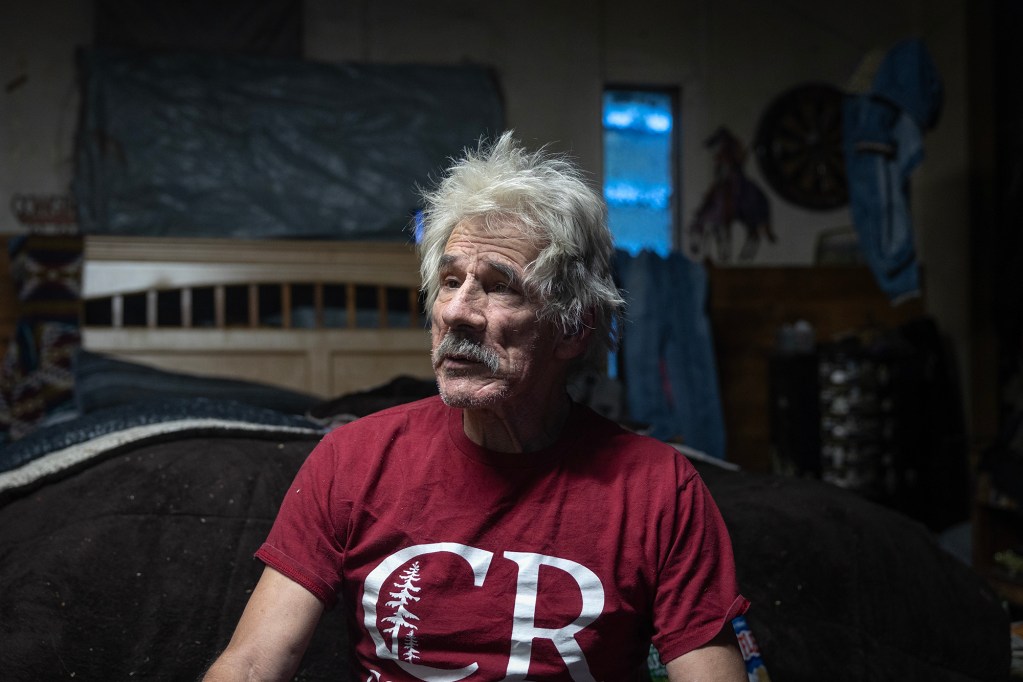
Nelson said he’s certain he would be in prison if not for Shelton. “He believed what I told him,” he said. “Without that investigator, you don’t have a chance.”
Marshall and his mother have since died.
Shelton retired from defense investigation last year. He was initially hesitant to talk about the Nelson case and insisted that he had only been doing his job. He said he doesn’t want to be the hero of a story that is still, at its core, a tragedy. “Imagine being Bill Cook,” he said.
Although CalMatters was unable to reach Willie’s parents, a Facebook group dedicated to his memory, which has been inactive since 2016, includes posts from family members who express the belief that Nelson is guilty.
That’s what compounds the tragedy of the case for Kayfetz.
“They took a decades-old bandage off of these people’s hearts and just ripped it off,” she said. “It’s every kind of miscarriage of justice.”
Last year, the Siskiyou public defender’s office finally got its first staff investigator. Kayfetz said she needed to “clone him.” She cobbled together funding from a couple of new grants to hire a second, who started earlier this year. But she said it’s still not enough.
The Nelson case, she said, “rose and fell on the quality of the investigation.”
For his part, Andrus said he doesn’t believe Shelton’s work had much impact on the case. He said the prosecutors and sheriff’s deputies had always known that Marshall was “a compromised witness.”
“There were so many nails in the coffin of Steve Marshall’s credibility that it didn’t need more,” he said. “He was not the kind of person that we would want to rely on in a murder case.”
He said they had a duty to “look into his statement, see if we can corroborate it.” And Nelson had confessed. The other evidence they gathered, he acknowledged, “was not very strong.”
They pushed the case forward anyhow.
This article was originally published on CalMatters and was republished under the Creative Commons Attribution-NonCommercial-NoDerivatives license.