

| Siskiyou News | June 16, 2026
YREKA — The State Water Resources Control Board has reinstated conditional curtailments for numerous junior water rights in the Shasta River watershed after flows at the Yreka USGS gage dropped sharply below the required minimum.
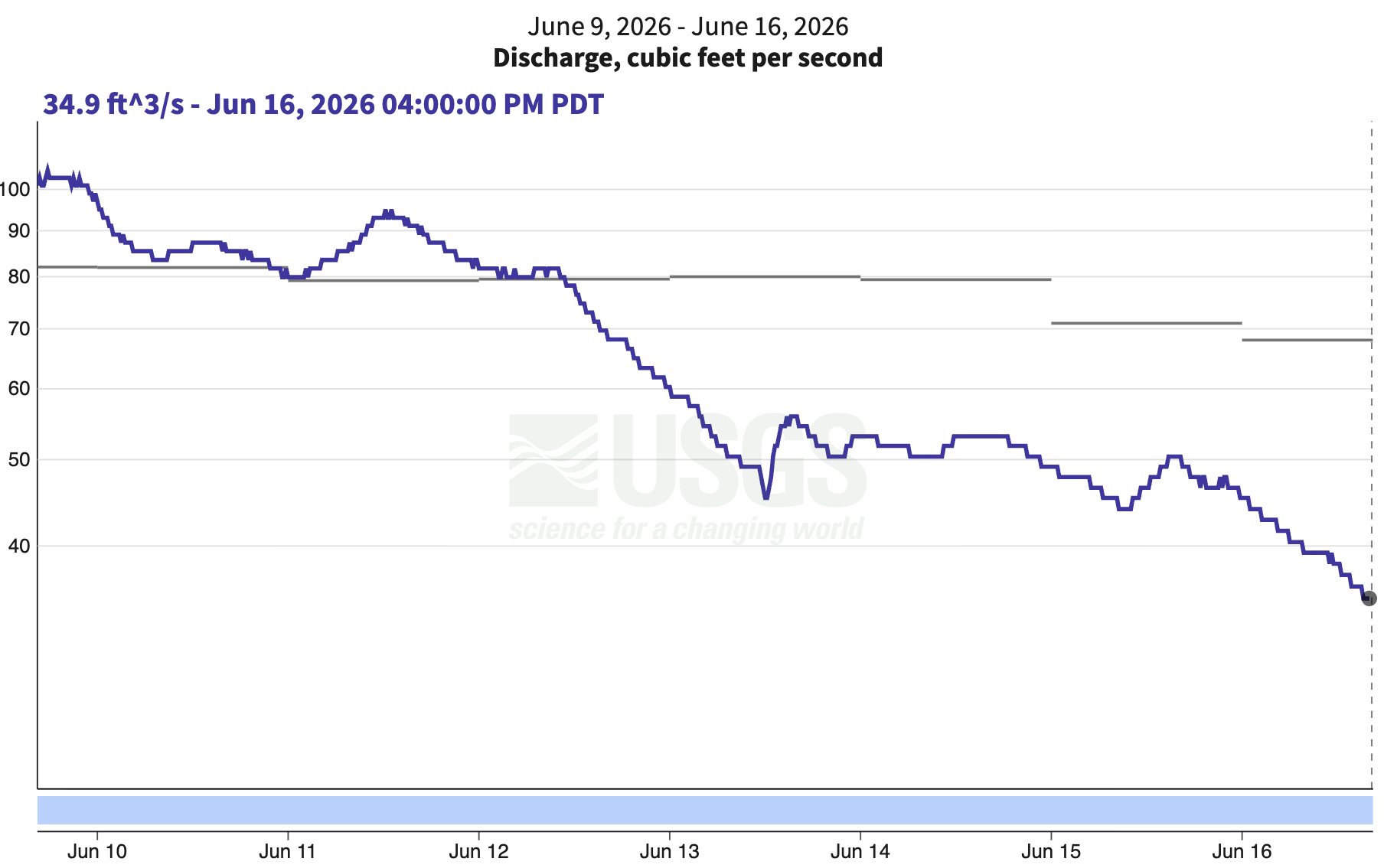
As of early morning on June 16, 2026, flows measured approximately 39.3 cubic feet per second (cfs) at the gage — well under the 50 cfs minimum instream flow requirement in effect from May 1 through September 15. The Board issued Addendum 6 to Order WR 2024-0006-DWR today, targeting appropriative surface water and groundwater rights with priority dates of or junior to November 1, 1912.
The move follows a volatile spring and early summer. Flows started above 200 cfs in early April, ranged mostly 61–100 cfs through much of May, spiked briefly to 172 cfs on May 30 with precipitation, then began a steep decline around June 11 amid rising temperatures. By June 13, flows had fallen to 45.3 cfs; they briefly recovered above 50 cfs before dropping again. As of June 15 afternoon, the gage read 46.5 cfs. With negligible snowpack remaining and little precipitation forecast, the Board acted to protect minimum flows for fisheries.
Who Is Affected
The curtailment applies to post-adjudication appropriative rights and certain senior appropriative rights junior to November 25, 1912 (as outlined in the Emergency Regulation section 875.5). The lengthy Attachment A to Addendum 6 lists dozens of rights holders across the watershed.
- Most junior rights (priority date of or junior to January 1, 1958 — highlighted in orange in the attachment): These diverters are conditionally curtailed and may only divert if they strictly follow additional conditions. Many involve appropriative groundwater rights.
- Rights with priorities from November 25, 1912, through December 31, 1957: These are also conditionally curtailed and must coordinate with the Scott Valley and Shasta Valley Watermaster District to manage or curtail diversions in priority order as needed to sustain the 50 cfs minimum.
Notable entries include multiple rights held by the Montague Water Conservation District, Lake Shastina Community Service District, City of Weed, City of Yreka, Grenada Sanitary/Irrigation District, Big Springs I.D., California Department of Fish and Wildlife, and numerous private individuals and trusts (including Griset family entries, Sousa, Del Dotto, Meamber 2000 Trust, and others). Some decreed rights from the early 1900s (e.g., Webb Brothers Company interests from 1915 and earlier) are also listed as conditionally curtailed.
The Board notes that even the most junior rights may have limited opportunities to divert when water is available under their priority without harming seniors, provided strict coordination occurs.
Strict Conditions for Junior Rights (≤ Jan. 1, 1958)
Holders in this category must:
- Consult the Watermaster first — Receive written or documented confirmation that water is available under their priority and that diversion will not impact more senior rights. No diversion until confirmation is received. Records must be kept and provided to the Board upon request.
- Notify immediately when diversion starts, changes, or stops — Include amounts diverted.
- Cease diversion immediately upon notification from the Watermaster or Board that water is no longer available under priority or that continued diversion would prevent meeting minimum flows or senior rights.
- Monitor gages daily — Check the Yreka USGS gage and the Department of Water Resources Shasta River at Grenada Pump Plant (SPU) gage. Contact the Watermaster if Yreka flows are at or below 55 cfs, nearing the minimum, or if SPU flows have declined from the prior day. Diversion is prohibited whenever the minimum flow requirement is not being met at Yreka.
Failure to comply is subject to enforcement under the Emergency Regulation.
Limited Exceptions Remain
Certain diversions may continue with proper documentation submitted to the Board:
- Non-consumptive uses (e.g., run-of-river hydropower with returns to the same stream).
- Minimum human health and safety needs (drinking, cooking, washing, critical infrastructure; firefighting explicitly allowed).
- Minimum livestock watering (per section 875.3 of the Regulation).
Previously submitted reporting/certification forms remain valid unless updates are needed.
Background and Local Stakes
This Addendum builds on the original June 2024 Order and subsequent addenda that have suspended or reinstated curtailments as conditions warrant. The underlying Scott-Shasta Drought Emergency Regulation — extended through 2031 by AB 263 — prioritizes minimum flows to support salmonids in the Klamath system.
For Siskiyou County’s rural communities, the timing hits during peak irrigation and livestock season. The watershed supports agriculture, municipal supplies, and longstanding ranching operations. Historical data cited by the Board shows Shasta River flows are heavily influenced by surface diversions and groundwater pumping during the irrigation season.
The Scott Valley and Shasta Valley Watermaster District will play a central coordination role. Affected rights holders should contact the Watermaster promptly at [email protected] for consultation or reporting. Board questions go to [email protected] or (916) 327-3113.
The full Addendum 6, Attachment A (detailed list of rights), and related documents are available on the State Water Board’s Scott-Shasta page: waterboards.ca.gov/drought/scott_shasta_rivers.
Staying Ahead
The Board says it will continue monitoring gages, forecasts, and watershed conditions and may adjust curtailments. Local diverters are encouraged to coordinate proactively with the Watermaster to potentially avoid or limit deeper restrictions.
This is the latest chapter in the ongoing tension between state-mandated instream flows for fish and the viability of traditional rural water uses in the State of Jefferson region. Siskiyou News will continue following developments, compliance impacts, and any local responses.
Readers with water rights in the watershed should review the full attachment and contact the Watermaster or Board immediately for guidance specific to their rights. Public comments or tips on local impacts can be sent to [email protected].
— J.A. Martin is publisher and reporter for Siskiyou News, covering Siskiyou County government, water issues, and rural accountability.