
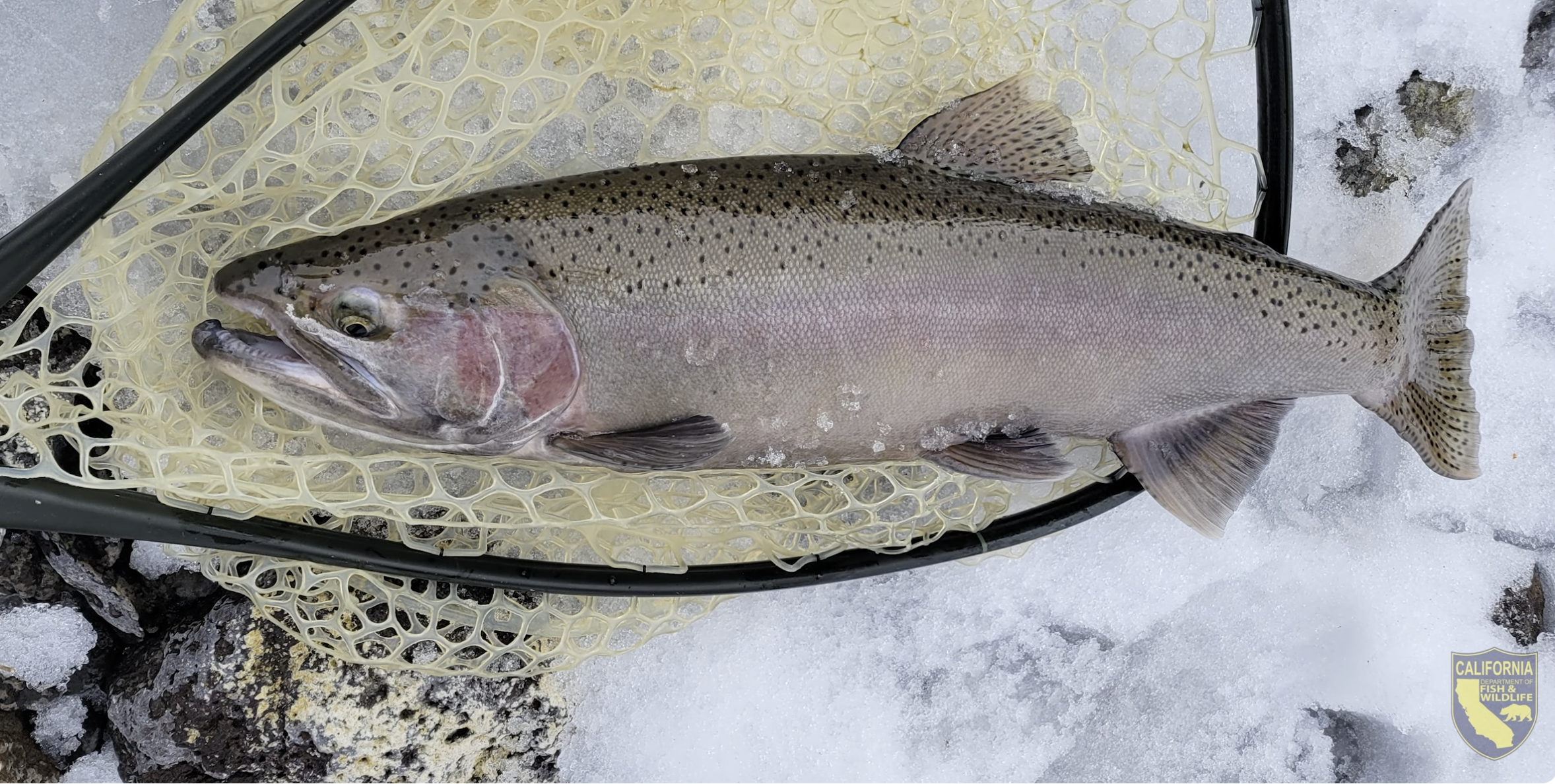
The California Department of Fish and Wildlife (CDFW) successfully rescued approximately 5,800 adult Eagle Lake rainbow trout this spring, returning the fish to Eagle Lake after they became stranded in the lakeโs primary tributary, Pine Creek.
The emergency operation, which took place over four days in March and April, represented the largest such rescue in more than a decade. More than 25 CDFW biologists and hatchery staff, along with community volunteers, participated in the effort.
โThese fish are long-lived so thereโs a very good chance that fish returned to the lake could return in subsequent years to spawn again,โ said Paul Divine, CDFWโs District Fisheries Biologist for Lassen and Modoc counties. โAnd itโs also putting adult-sized fish back in the lake that could be enjoyed by anglers to catch as well.โ
Eagle Lake rainbow trout are endemic to the lake and Pine Creek. The species supports both a popular recreational fishery and statewide hatchery operations, with fish stocked in waters from Modoc Countyโs Lake Annie to San Diego Countyโs Cuyamaca Lake.
Fishing Season Opens Saturday
Eagle Lake opens to trout fishing this Saturday, May 23. Anglers may keep two fish per day with a possession limit of four. Catching an Eagle Lake rainbow trout in the lake counts toward CDFWโs Heritage Trout Challenge. Anglers are encouraged to report their catches through the California Inland Recreational Angler Survey (CIRAS).
Before the rescue, CDFW met its spawning goals by collecting 1.3 million fertilized eggs from 320 pairs of trout. Roughly 170,000 of those offspring will be returned to Eagle Lake to bolster the local fishery.
Climate-Driven Challenges
Fish strandings in Pine Creek are not uncommon โ CDFW records show rescues dating back to 1959. The lower 25 miles of the creek are seasonal and rely entirely on snowmelt.
Unusually warm weather in February and March this year accelerated snowmelt and triggered an early spawning run. With below-average snowpack that disappeared quickly, many trout became trapped in deeper pools as flows dropped. Biologists used backpack electrofishing units, block nets, and dip nets to collect the fish, which ranged from 9 to 24 inches long, with some weighing 4 to 5 pounds.
โPine Creek has always been unpredictable, but weโre seeing more extremes over the last 10 years,โ Divine said. He has managed the Eagle Lake fishery for nearly 20 years.
Pine Creek has dried up completely three times in the past decade, blocking trout access to spawning grounds. This yearโs spawning operations in March were the earliest conducted in 40 years.
The rescued trout have now been safely returned to Eagle Lake, helping preserve this unique native population and supporting both natural reproduction and recreational angling in the region.