
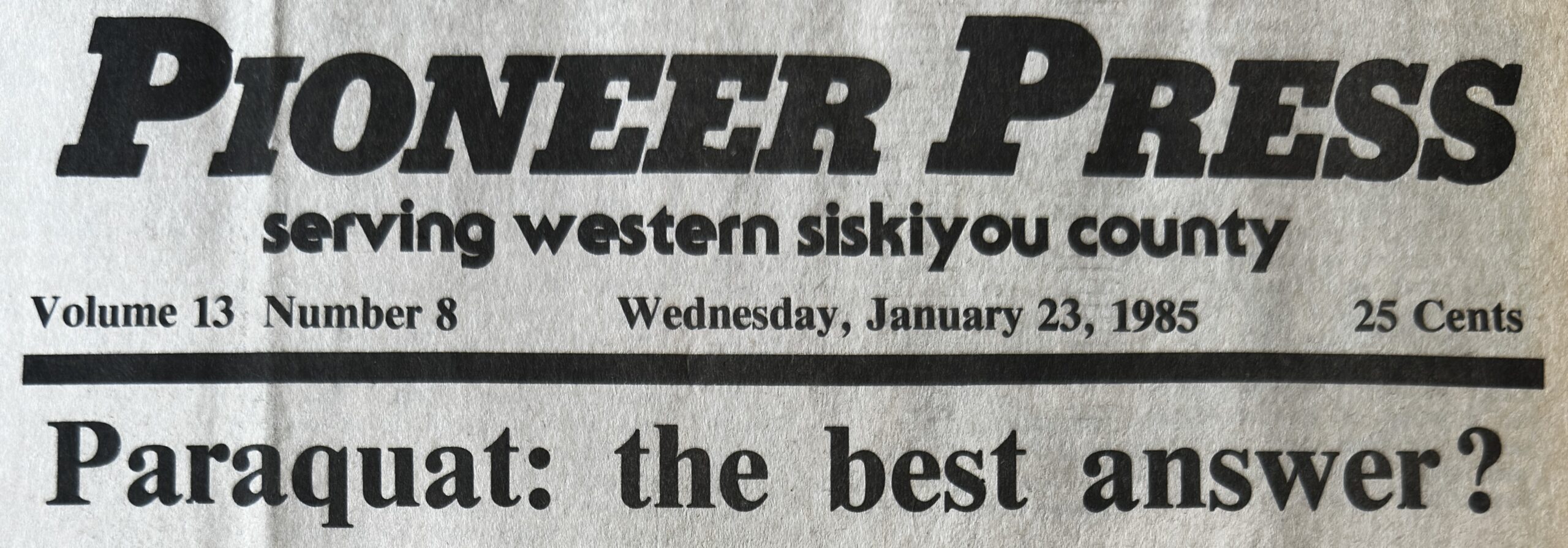
DORRISโOn a Tuesday morning forty years ago this January, this newspaper published what seemed then like a cautionary tale from a distant front in the War on Drugs. Mark Slackโs January 23, 1985 headlineโโParaquat: the best answer?โโwarned of federal plans to rain poison down upon the Klamath National Forest from helicopter gunships, all in the name of marijuana eradication.

This past Tuesday, the poison didnโt fall from the sky. It fell off a truck.
At approximately 8:43 a.m. on March 17, a 120-gallon tank of Gramoxoneโthatโs paraquat dichloride to the chemists, โPOISONโ with a skull and crossbones to the rest of usโtumbled from a big rig as it navigated downtown Dorris. Sixty gallons of the concentrated herbicide, the same chemical Slack reported on when Ronald Reagan was beginning his second term, pooled across Highway 97 and seeped toward Akiโs Auto Body & Towing.
The result was everything that Forks of Salmon reader feared in โ85, delivered not by federal agents but by gravity and bad luck.
โI live and own private property in the Klamath National Forest,โ that unnamed reader told Slack four decades ago. โI support the eradication of marijuana efforts as long as the efforts do not include tactics such as spraying poisons. This means is far too threatening to the people and wildlife who live in the area.โ
Apparently, itโs also threatening to the people who live near the highway.

Siskiyou County Sheriffโs Office issued a shelter-in-place order for roughly 600 Dorris residentsโan eerie lockdown forcing families to tape windows and seal doors against the very chemical Slack warned โcan be absorbed by inhalation or through the skin; if swallowed, however, as little as one teaspoonful can kill.โ Ten locals sought medical screening; one was hospitalized overnight before release.


Emergency crews scrambled through the day, racing to block storm drains before the chemical, which โdissolves very easily in water,โ could contaminate the water table. As Slack noted in โ85, paraquat becomes airborne with disturbing efficiency. This week, light variable winds at 4-5 mph complicated containment efforts, with the National Weather Service issuing a hazardous materials warning for the area.
Back in 1985, Slack told the story of Scott Wilson, a 25-year-old Florida gardener who accidentally sprayed paraquat on his face and clothing. He washed up, went back to work, and five days later was rushed to the hospital barely breathing. After a lung transplant, he died two months later.
It was a horror story then. It was a phone tree message this week.
The irony runs deeper than the spill. In 1984, Chevronโyes, the manufacturerโprotested the DEAโs plan to aerial-spray marijuana crops with paraquat. A company vice president wrote to federal drug agents that the label bore the word โPOISONโ and the skull and crossbones for good reason. โWhen used as a weed killer, paraquat is accomplishing by chemical means what can be done with a hoe and bonfire,โ he wrote. โThe hoe, in this instance would be the preferred means.โ
The DEA ignored him in โ85. They sprayed anyway.
And now, forty years later, as California Office of Emergency Services and the Siskiyou County Hazardous Materials Team spent days scrubbing Highway 97 with absorbent materials and pressure washers, that Chevron warning echoes like a prophecy. The chemical that was too dangerous to spray on pot plants in national forests proved too dangerous to spill on asphalt in downtown Dorrisโsame poison, different decade.
Mark Slackโs article ran on page one of the old Pioneer Press continued to page ten sandwiched between local high school sports and community calendar items. It was โrural gonzo journalismโ before we had a name for itโquestioning federal overreach, centering the voices of locals over bureaucrats, and asking the uncomfortable questions about what happens when law enforcement decides that โcost effectiveโ matters more than โsafe.โ
This week, we didnโt need to ask. We just needed to shelter in place.
The California Highway Patrol is investigating how a tank containing enough poison to kill a small city fell off a truck in the first place. The Dorris water supply, mercifully, tested cleanโthis time.
But somewhere in the archives, Mark Slackโs typewriter ribbon is still inked with the warning he typed on January 23, 1985: โPhysicians from coast to coast insist that paraquat must be strictly controlled. Its use should be never put in the hands of the general public, they say.โ
This week, it fell into the hands of a truck driver and a pothole on Highway 97. And a town held its breath.
Mark Slackโs original 1985 reporting, โParaquat: the best answer?,โ appeared in the January 23, 1985 edition of the Pioneer Press.