
By Dan Walters, CalMatters
This commentary was originally published by CalMatters.
Sign up for their newsletters.
Construction of the 1,911-mile transcontinental railroad connecting California with the eastern half of the United States began in 1863, while the nation was engaged in a bloody civil war, and was completed six years later when its two legs were joined at Promontory Summit in Utah.
California’s bullet train project was launched in 2008 when voters passed a $9.95 billion bond issue on promises that it would be completed by 2020, whisking passengers from one end of the state to the other.
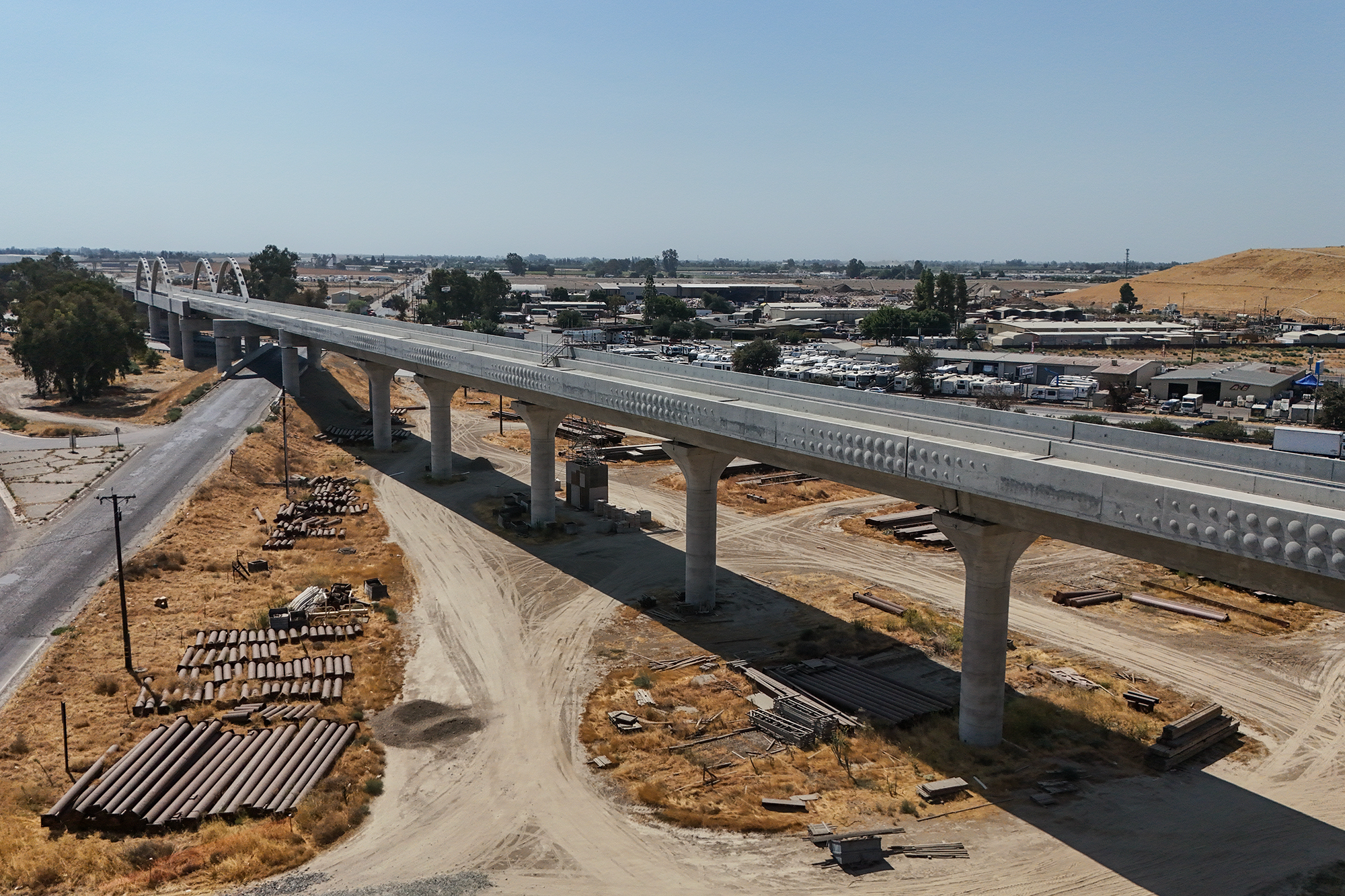
Eighteen years later, an initial segment in the San Joaquin Valley, linking a station near Merced with one near Bakersfield, is little more than a skeleton of concrete supports, dubbed Stonehenge by some critics, with no track, no trains and, therefore, no service.
It is a hot mess that’s contributing to California’s reputation for managerial incompetence — as a recent episode of CBS network’s “60 Minutes” underscored. The program’s interviews with project officials ripped open their inability to explain how and when the bullet train would be completed.
Oddly, as the project’s financial viability has shriveled, Gov. Gavin Newsom, once highly critical, has become its most visible champion, staging media events to tout even its tiniest advances.
Twelve years ago, while serving as lieutenant governor, Newsom was scornful. In a 2014 recorded interview, he concluded, “The facts seem overwhelming that this project is not going to materialize in our lifetime.”
Five years later, in his first State of the State address, Newsom once again questioned the bullet train’s viability.
“Let’s be real,” Newsom told legislators. “The project as currently planned would cost too much and take too long. There’s been too little oversight and not enough transparency. Right now, there simply isn’t a path to get from Sacramento to San Diego, let alone from San Francisco to L.A.”
Newsom’s remarks were widely interpreted as him wanting to pull the plug. But after construction unions and other advocates pushed back, he insisted he wanted to see the project become reality, with a lengthened the San Joaquin Valley segment.
Last February, his cheerleading took him to Kern County to celebrate a small supportive project.
“Here on the high-speed rail system, we’re now in the process of starting to lay track, 119-mile first phase, fully funded because of the investments we’ll make through the cap-and-invest program through 2045,” he said.
“Seventeen hundred people every single day — union jobs — go to work on this project. Fifty-eight large-scale structures have been completed; 29 others under way; 99% of the environmental work done. All of the hard work is behind us. Now we’re going to see the fruits of that. We’re going to start seeing precisely what you see here, real tracks, real progress.”
All of the hard work done? Not by a long shot.
At best, it will take another six years — the same time span of the transcontinental railroad — before trains are carrying passengers, and that would only be between stations near two rural cities. Moreover, to get that far the project must borrow construction money by pledging its $1 billion a year from emission auctions.
The saga’s latest chapter is a new “business plan,” pegging the cost of linking San Francisco to the Los Angeles area by 2040 at $126 billion.
In response, the Legislative Analyst’s Office issued a critique that listed the plan’s shortcomings, concluding that it didn’t meet state law requirements for transparency on costs and other points.
The project was a mess when Newsom became governor; it will be a mess for his successor and it will probably be a mess when the next governor departs.
The old saying about beating a dead horse and hoping it will revive comes to mind.
This article was originally published on CalMatters and was republished under the Creative Commons Attribution-NonCommercial-NoDerivatives license.