

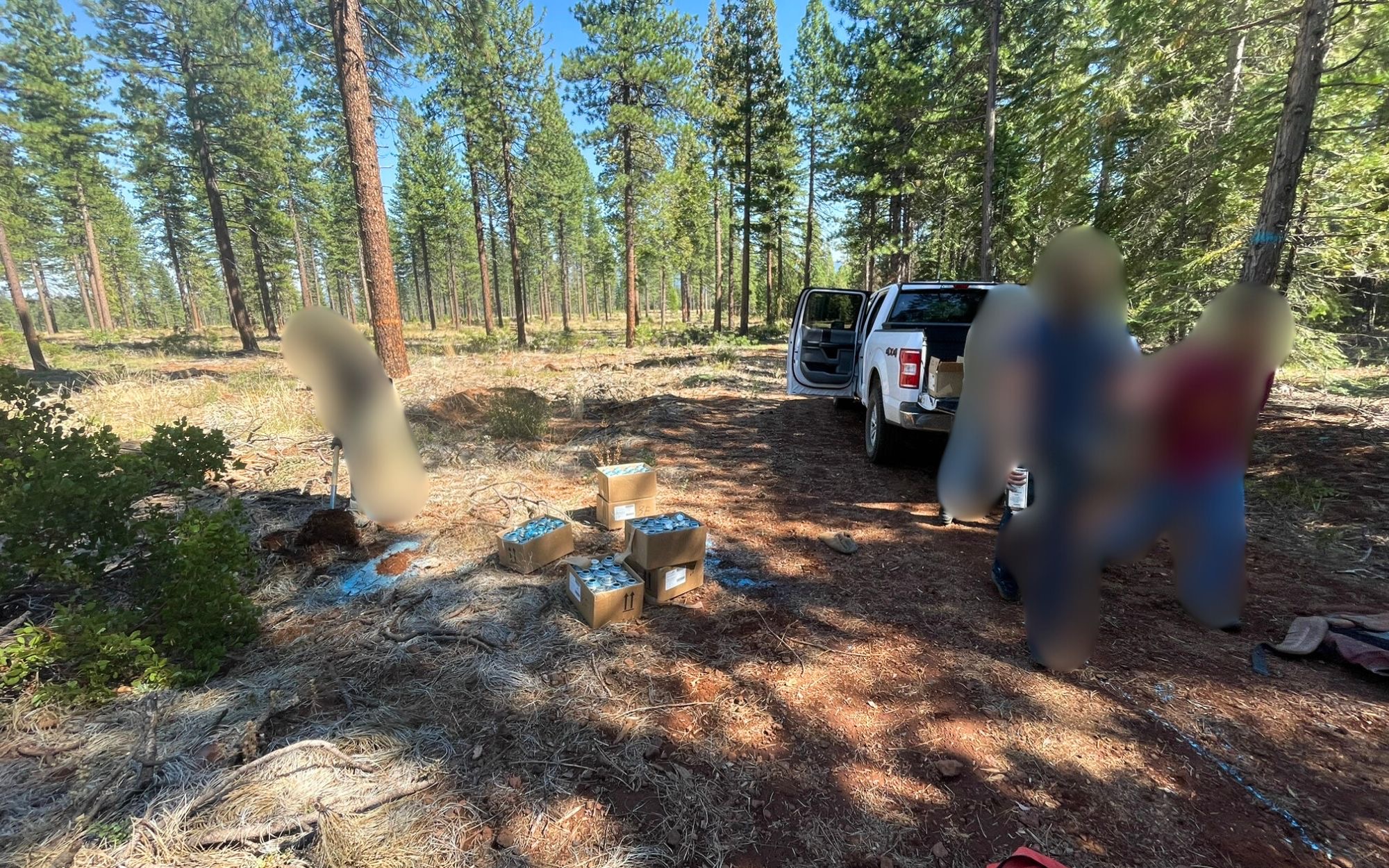
MCCLOUD, California – The California Environmental Protection Agency (EPA) with the Siskiyou County Waste Management Unit are investigating a case of illegal dumping from the U.S. Forest Service (USFS) Shasta McCloud Management Unit. Additional action on this matter has been taken by the Mount Shasta Bioregional Ecology Center. This development is made possible by a local forester’s brave stand to expose wrongdoing and stop a looming environmental injustice from affecting their community.
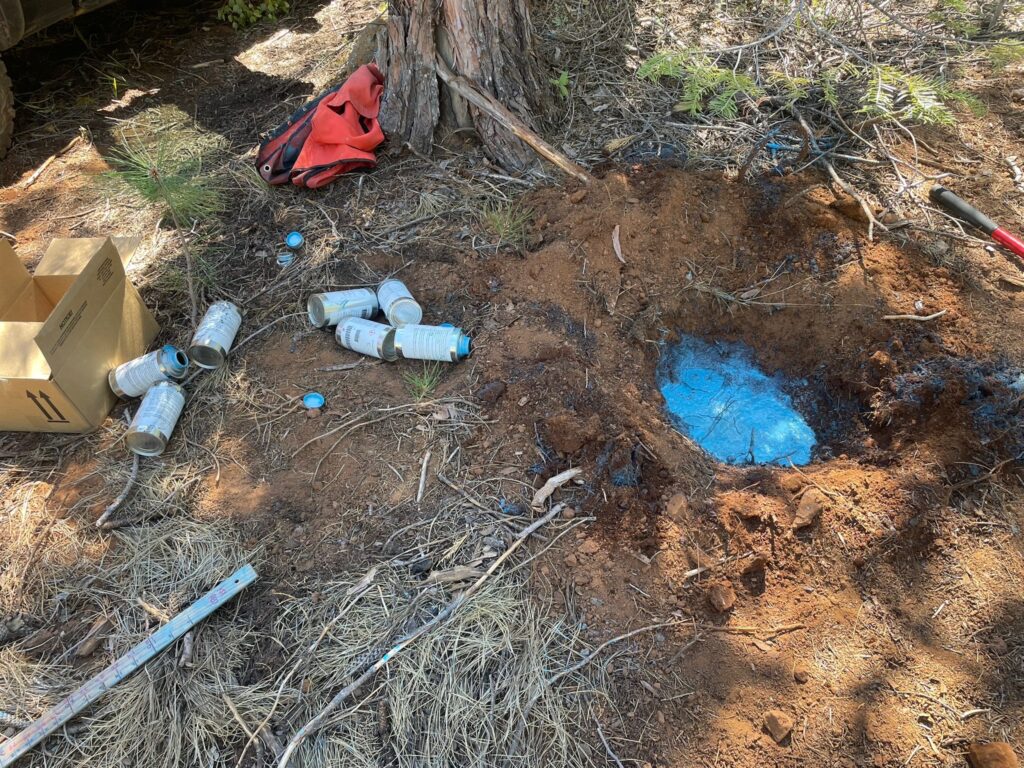
According to Andrew Wyatt, a forester hired by Black Fox Timber Management Group based in McCloud, he first observed the dumping of tree marking paint in September. Photographic evidence obtained by Wyatt shows a Black Fox crew contracted by the USFS digging holes about 1-foot deep and dumping a paint-water mixture into the soil. The whistleblower alleged that this illicit activity occurred over 2 months as the crew marked a mixed conifer stand with pine, cedar, and fir located in the Pondosa area east of McCloud. Wyatt reported that, when confronted about this wrongdoing, the project supervisor responded that it was part of the protocol verbally instructed by the USFS.
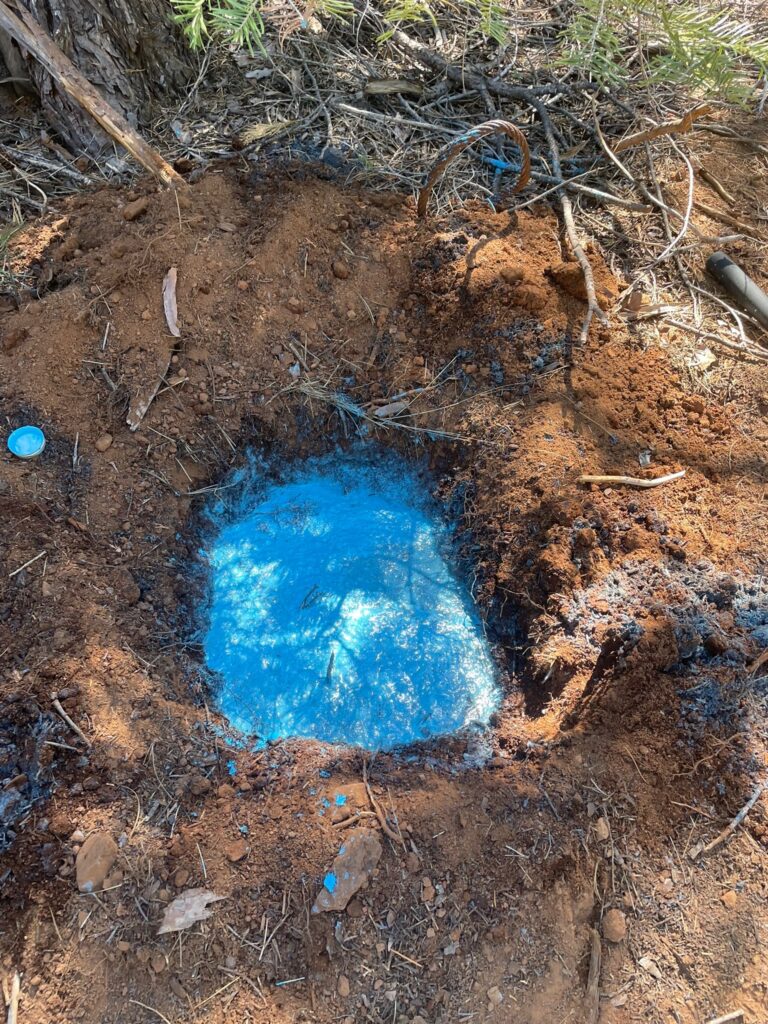
“Based on my observations while working on the project, I estimate over 200 gallons of paint-water were dumped in holes along Forest Service roads within the timber sale unit,” commented Wyatt. “Other employees said to me that similar practices have been carried out for the USFS for many years,” he added.
The tree marking paint used by the USFS in the Shasta-Trinity area contains 800 grams per liter of volatile organic compounds (VOCs), according to the LHB Industries product labeling. By comparison, the California Air Resources Board’s 2019 Suggested Control Measure for Architectural Coatings sets the legal VOC limit for industrial maintenance coatings at 250 g/L. VOCs are concerning because they can move from soil into groundwater due to their solubility and volatility, posing risks to drinking water and aquatic ecosystems, according to the U.S. Agency for Toxic Substances and Disease Registry. The U.S. Geological Survey notes that VOCs can persist in the subsurface for long periods, creating the potential for extended environmental contamination.
“What I observed may just be the tip of the iceberg,” said Wyatt. “Unfortunately, there may be more Forest Service districts and contracted companies complying with this terrible practice across the country.”
In Siskiyou County, the Environmental Health Division is responsible for overseeing how hazardous waste is handled — including its generation, storage, labeling, and disposal — under California state law. California’s Penal Code § 374.3 makes it illegal to dump or abandon waste on public land or property, while the Hazardous Waste Control Law sets strict rules for how hazardous materials must be managed. The California Department of Toxic Substances Control (DTSC) enforces these regulations statewide, ensuring that businesses properly label, store, and transport hazardous substances in accordance with both state law and the federal Resource Conservation and Recovery Act (RCRA).
The disposal of large amounts of VOC-laden paint in public forests raises serious environmental and public health concerns. These forests are not just timberlands—they are places where the surrounding communities hunt, fish, forage, and recreate. The possibility of long-term persistence of VOCs in the environment means that improper disposal today could impact the safety and enjoyment of these public lands for years to come.
“My past work as an environmental scientist and training in sampling toxic soil gave me the insight to clearly understand the possible consequences of what I was witnessing,” stated Wyatt. “I felt I had an ethical obligation to report it. Staying silent would have gone against everything I believe in as a scientist, forester, and conservationist.”



11 Comments
My Dad, Wade McCollum, was the caretaker out there and kept an eye on all activities going on. Since he died in 2011 all kinds of “getting away with it because we can “. My father had integrity and honor in doing things right. These people know this is wrong…
Why are their faces blurred? These people need to be publicly shamed! I have some garbage I’d like to dump in their backyard. B S send the to jail
Jail is so extreme, grow up. Are you calling for leadership of polluting corporations to go to jail?
Yes Renee I am!
I am a CEO of a corporation and yes that is exactly what I am saying. Knowingly dumping toxic paint in the forest is wrong and there isn’t an excuse for it. My company has disposed of hazardous waste since 1991 responsibly. Costing my company tens of thousands of dollars.
I also live East of McCloud, so this is my backyard, where I hike and fish. So Renee no I don’t want paint dumped in the forest by anyone. If you don’t mind I have plenty of toxic waste I can have brought to your backyard. Hold them responsible Renee!
WTAF????
I think the article is misleading either on accident or on purpose. That is also not USFS wide policy. Either that crew is misunderstood in their action, or misunderstood what theyre supposed to do.
I highly doubt “dump the paint in a hole in the ground” is written in any protocol, hence the verbal instruction. Properly disposing paint to avoid polluting shouldn’t be that hard to understand in my opinion… And I would assume part of the investigation would be looking into other forest service districts to determine how widespread or systemic the negligence is.
This has been protocol for as long as I can remember. I dont understand the outrage now. It’s been done like this my whole life and was always public knowledge. I get changing it but the timing of the outrage is weird to me.
It was never ‘protocol’ on any Forest I worked on. Every can was accounted for and tracked from when ordered from the manufacturer to using it in the field to proper disposal, including tracking the empty containers. Each can had a serial number. The inventory better match up at the end of every day or no one went home until the discrepancy was cleared up.
Accountability is paramount. Thank you, Andrew Wyatt, for standing up and doing the right thing!
I was on a FS marking crew that was instructed to do this.