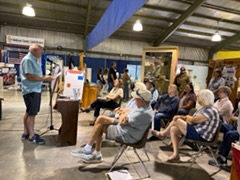

In the heart of Siskiyou County, amidst the tranquil beauty of Northern California, the Siskiyou Writers’ Club recently held a public reading event that celebrated the creative spirit of its members.
The event, hosted by the Siskiyou Family YMCA, was more than just a reading; it was a gathering of minds and hearts. As attendees listened to each other’s stories, it reminded me of the power of words to connect us to each other and to the larger world around us.
The Siskiyou Writers’ Club continues to be a beacon for literary enthusiasts in the region, fostering an environment where writers can grow and share their work. With members like Mike Grifantini and Carolyn Anderson, Yreka Bob, The Jansens, and I am forgetting a few others. All contributing such rich narratives, it’s clear why this community holds a special place in the literary landscape of Northern California.
For those who missed the live readings, stay tuned for future events and workshops by contacting Jami at the Siskiyou YMCA or visiting their website for more information. As the club says, every story told is an invitation to explore new horizons, and every poem shared is a bridge to understanding. Join them in their next gathering for another round of literary magic and community connection. check them out on FaceBook for more information and meet ups.
Among the many talented writers, I have two stories to share with you: Mike Grifantini with his piece “Conversation at 8 a.m.” and Carolyn Anderson with “The Preventorium.”
Conversation at 8 A.M.
By Mike Grifantini
Mondays, Wednesdays and Fridays are always the same!
As I am finishing my breakfast, a soft, melodic (definitely feminine) voice wafts to me, from somewhere over my right shoulder: โIt is time to get going. You know that it will be good for both the body and the mindโ, and the voice continues: โand, you will feel good about what you have accomplished.โ โOther peopleโ, the voice coos seductively, โwill look at you, and admire your rippling abs and biceps and wonder โhow did he do it!โโ โOf course, you can tell them that โit took work but I am rotten glad that I did it.โโ The voice adds, almost as an afterthought, โand you know that other people can do it too. They too can have ripped pecs and gluts. They too can be ogled and admired. They too can get healthier.โ
Yes, this is how the days start each time I head toward the YMCA.
But, as I am heading out the door, pulling on my ugly Santa sweater and making sure I have my YMCA bar-code, another, darker voice pipes in– over my other shoulder. I stop, there in the garage, and listen to the gruff words. He (yes, the voice is definitely a he), starts off by saying I should look out at the sky! He often says: โwow, it sure looks like rain,โ or, โthat wind is really howling, donโt you think?โ, or โMain Street has so many pot holes it will crack your suspensionโ or โit is so hot today that the Yโs air conditioner wonโt keep us (he speaks of he and me as โusโ), it wonโt keep us cool and we will get all sweaty and stinky.โ
I sit there in my beautiful, green Nissan Xterra, pondering the risks of torrential rain, of hurricane-force winds, of extreme heat and impassable streets. Then the soft, melodic voice reaches out again: โthink of your health, plus the good that it does for you mentally, yes, and donโt forget those abs and biceps and even your calvesโ all those sculped parts of your body!โ I shrug, start up my Nissan and head toward town.
As I get to speed I turn on the radio and hear the rhythms of good old Rock and Roll, โY-M-C-A, Y-M-C-Aโ, until the gravelly voice butts in, louder and with more force: โHaโ, the voice says, โyou think people look at you with admiration!! You think they see a ripped body? All they see is a bundle of wrinkles. Just an old guy that doesnโt realize that it would be much easier to stay home and eat Doritos. That is what people seeโa guy that doesnโt know how to have fun! You think you are staying heathy! Ha. Your cartilage is breaking down and thinning by the minute, your kidneys are being stressed every time you go on the treadmill, your heart is getting worn down to the nub, your veins are hardening by the minute. You think that all of this, thisโW O R K–is good for you!??โ
Another Rock and Roll song picks up, โLetโs get physical, physicalโ–the soft, pleasant voice comes back, gently nudging aside the lyrics: โIgnore that โother–guy. What does he know? If anyone is a bag of wrinkles, it is he. You should see himโof course you canโt, but if you could you would be shocked! O.k. letโs face it, you donโt have abs of steel and you probably never will, but you are keeping your body going and feeling good about it. Maybe no one will ever wish to have your biceps, but you will feel proud of yourself–that means a lot. Remember a positive attitude is 95 percent of the battle.โ
The rough drawl elbows inโsounding almost as if in pain and agony. โYou think that all of this will let you live longer? Ha. You are dead meat! Your time is running, like sand through an hourglass, YOUR DAYS ARE NUMBERED! Why not lay back and restโthereโs a football game on T.V. now. That bag of chips is in your cupboard and, that six-pack in your fridge! Turn around and head homeโyou still have time! Be realistic–people look at you and see โboringโ written in big letters! And those dumb shorts and t-shirt you wear! Couldnโt you, at least, do better??โ
The soothing and mellow presence now does her own butting: โYou know that I am right and that otherโโthingโโis wrong. Keep driving to the Y, regardless of snow, Force 5 winds or back-breaking chuck holes. They donโt matter. Your body will feel better, your mind will feel better. That is what matters. And you will have defeated that ugly–thing another day.โ
I pull into parking lot, scan my pass and say hi to Rose. I stride purposefully to the dressing room, put on my special paisley t-shirt and favorite plaid shorts, then continue to the exercise room, making sure to suck in my stomach as I walk by the full-length mirror.
THE PREVENTORIUM
By Carolyn Anderson
My mom had just turned eleven years old, in 1937, when her daddy died from Tuberculosis. He was 42 years old. His death left my grandma, at the age of 36, a widow with five children. Through her immense grief, she tried to provide for the children by taking in boarders, making and selling candies and midwifery. Whether for financial reasons, or for the health of the children, soon after the fatherโs death the two youngest children, my mom and her brother, were sent from their Yuma, Arizona home to a Preventorium in Oracle, Arizona, 15 miles north of Tucson. It was advertised as โa summer health campโ for children ages 2-16, to prevent the spread of TB to others that were at risk of contracting the disease. The focus was on children who were poorly nourished, underweight, anemic, sub-par in their health, and usually from low-income homes. The Preventoriumโs strategy was to fortify the health of the children with fresh air, nutrition and sunlight. But, by removing them from their homes and isolating them from their families, it seems the childrenโs emotional well-being was overlooked. Parents could only visit once a month for two hours. No children or other family members were allowed to visit. It is 236 miles from Yuma to Tucson, and, as far as I know, my grandma was unable to visit her two youngest children, probably due to finances, lack of transportation, and the distance.
My mom and her brother were close in age and constant playmates. She was a very โprotectiveโ big sister. At the Preventorium the boys and girls were separated, so the only time they saw each other was through the fence that separated the boyโs from girlโs dormitories during their โother timeโ. Purportedly, the matron disliked boys and was especially mean to my uncle. Aside from being separated from their mother and siblings, the thing that most traumatically impacted my mom and uncle was their inability to be together and my momโs inability to protect her brother from the abuse of the matron. That is the most vivid memory I recall my mom telling me about their stay in the Preventorium; the rest I have learned from reading of othersโ documented experiences.
Documents report that when children entered the Preventorium, they all received the same haircut and โuniformsโ, which were like oversized diapers or loose bloomers called โdrapesโ. Clothing was limited to allow exposure to the fresh air and healing sun; no underwear or shoes. It was a strict, tightly controlled environment that demanded conformity to an excessively rigid daily regimen that included specific โhygienic breaksโ, with nurses recording every childโs bathroom productivity with military efficiency. Documents reported that the children were required to sleep only in the โproperโ position (on their backs, arms at their sides, head toward the door at all times). They were paddled if they deviated from that position.
The children were required to walk single file with their hands on their waists, and were administered cod liver oil daily. In addition, they were required to eat everything on their plate and not leave the table until they had consumed all of their meal. All activities were monitored and recorded.
My mom and uncle returned home TB-free and healthy, so it is speculative whether this โfresh air methodโ of achieving optimal health worked and was worth the trauma of being isolated from family and community. Perhaps the lesson shown is the resiliency of children, and their ability to adapt to such a cold, strict environment away from their families. It eludes me how institutions such as these Preventoriums failed to recognize the essential importance of both emotional and physical needs of the children. Iโm thankful my mom and uncle prevailed.
Carolyn Anderson March 2024
- Siskiyou Libraries Launch Summer of Learning
- Bill to Curb Disability-Access Lawsuits Against Small Businesses Stalls in Assembly
- Sacramento Man Charged with Bringing Explosive Material into Sacramento International Airport
- Justice Department Announces Results of Operation Spring Cleaning
- Yreka Library Offers Variety of Community Events in June